
Agenta vs qtrl.ai
Side-by-side comparison to help you choose the right AI tool.

Discover how Agenta's open-source platform helps teams build and manage reliable LLM applications together.
Last updated: March 1, 2026

qtrl.ai
qtrl.ai empowers QA teams to scale testing with AI while ensuring control, governance, and seamless integration.
Last updated: March 4, 2026
Visual Comparison
Agenta
qtrl.ai
Feature Comparison
Agenta
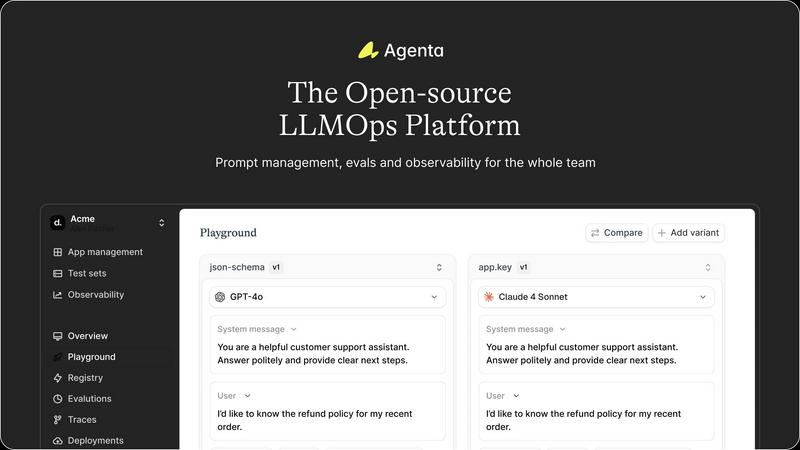
Unified Playground & Experimentation
Dive into a centralized workspace where you can experiment with different prompts, parameters, and foundation models side-by-side. This unified playground allows your entire team to iterate rapidly, compare results in real-time, and maintain a complete version history of every change. Found a problematic output in production? Simply save it to a test set and immediately begin debugging it within the same interactive environment, seamlessly closing the loop between observation and experimentation.
Automated & Holistic Evaluation
Replace intuition with evidence through a systematic evaluation framework. Agenta enables you to create automated test suites using LLM-as-a-judge, custom code evaluators, or built-in metrics. Crucially, it evaluates the full trace of complex AI agents, allowing you to scrutinize each intermediate step in the reasoning process, not just the final output. This deep visibility ensures you can validate that changes genuinely improve performance before they ever reach a user.
Production Observability & Debugging
Gain crystal-clear visibility into your live AI applications. Agenta traces every request, providing a detailed map of your LLM's execution. When errors occur, you can pinpoint the exact failure point—was it the prompt, the model, or a specific function? Furthermore, you can annotate traces with your team or gather direct feedback from users, and with a single click, turn any problematic trace into a permanent test case for future experiments.
Collaborative Workflow for Cross-Functional Teams
Break down the walls between technical and non-technical stakeholders. Agenta provides a safe, intuitive UI for domain experts and product managers to directly edit prompts, run evaluations, and compare experiments without writing code. This fosters true collaboration, ensuring the people with the deepest subject matter expertise can actively shape the AI's behavior, while developers maintain full API and UI parity for programmatic control.
qtrl.ai
Autonomous QA Agents
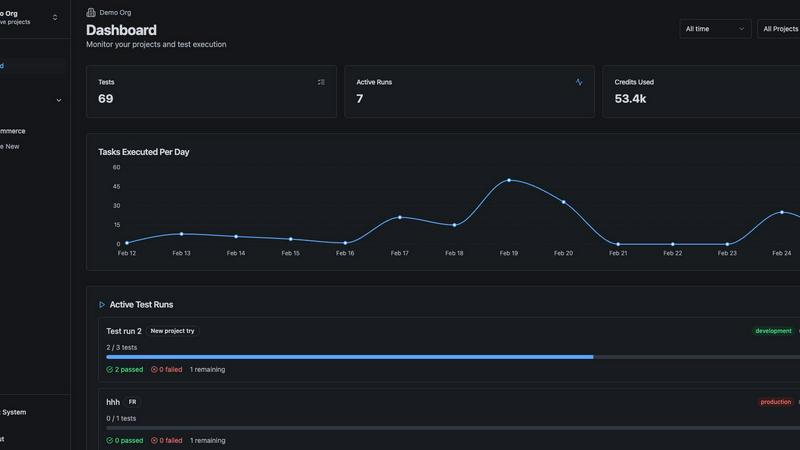
qtrl.ai's Autonomous QA Agents execute instructions on demand or continuously, allowing teams to run tests across multiple environments at scale. These agents operate within user-defined rules and ensure real browser execution rather than simulations, enabling reliable testing outcomes.
Enterprise-Grade Test Management
The platform offers a centralized repository for managing test cases, plans, and runs, providing full traceability and audit trails. With manual and automated workflows integrated, qtrl.ai is built to meet compliance standards and facilitate robust governance.
Progressive Automation
Teams can start with human-written instructions and progressively move to AI-generated tests when they feel ready. qtrl.ai suggests new tests based on coverage gaps, allowing teams to review, approve, and refine tests at every step of the automation journey.
Adaptive Memory
qtrl.ai features Adaptive Memory, which builds a living knowledge base of the application. It learns from exploration, test execution, and issues, powering smarter and context-aware test generation that improves with every interaction, ensuring continuous enhancement of the testing process.
Use Cases
Agenta
Streamlining Enterprise Chatbot Development
Imagine a financial services company building a customer support chatbot. With Agenta, product managers can draft and tweak prompt variations in the UI to ensure compliant and helpful tones, while developers integrate different models from OpenAI or Anthropic. The team can systematically evaluate each version against a test suite of tricky customer queries, monitor its performance in a staging environment, and quickly debug any hallucinated or incorrect advice before a full rollout.
Building and Tuning Complex AI Agents
For teams developing sophisticated multi-step agents that handle tasks like research or data analysis, Agenta is indispensable. Developers can use the platform to trace the agent's entire chain of thought, identifying which tool call or reasoning step failed. They can create evaluations that assess the quality of each intermediate result, not just the final answer, enabling precise tuning of the agent's logic and prompts for maximum reliability.
Managing Rapid Prompt Iteration for Content Generation
A marketing team using LLMs to generate ad copy or blog posts can use Agenta as their central experimentation hub. Writers and marketers can collaborate with engineers to A/B test different creative prompts and models, evaluating outputs for brand voice, SEO effectiveness, and engagement. All successful prompts are versioned and stored, creating a reusable library of high-performing templates that accelerate future content creation.
Academic Research and LLM Benchmarking
Researchers and data scientists can leverage Agenta to conduct rigorous, reproducible experiments. The platform allows them to manage countless prompt and parameter combinations, run large-scale automated evaluations against standardized benchmarks, and meticulously track results. This structured approach turns ad-hoc research into a formalized process, making it easier to validate hypotheses and publish findings.
qtrl.ai
Product-Led Engineering Teams
Product-led engineering teams can leverage qtrl.ai to scale their quality assurance efforts without losing control. The platform enables them to manage tests efficiently while gradually adopting automation, ensuring that product quality remains a top priority.
QA Teams Transitioning from Manual Testing
For QA teams moving beyond manual testing, qtrl.ai provides a structured approach to integrate automation seamlessly. Teams can start with simple test management and evolve to utilize AI-driven agents, making the transition smoother and more efficient.
Companies Modernizing Legacy Workflows
Organizations looking to modernize their legacy QA workflows can benefit from qtrl.ai's comprehensive features. The platform supports existing tools, allowing teams to integrate modern testing practices without disrupting established processes.
Enterprises Requiring Governance and Traceability
Enterprises that demand strict compliance and audit trails will find qtrl.ai perfectly suited to their needs. With full traceability and robust governance features, teams can ensure that their quality assurance processes meet regulatory requirements while maintaining high standards.
Overview
About Agenta
What if the journey of building with large language models felt less like a perilous expedition and more like a guided discovery? Agenta is an open-source LLMOps platform crafted to illuminate the path for AI teams navigating the complex terrain of modern LLM development. It transforms the often chaotic and intuitive art of prompt engineering into a structured, collaborative, and evidence-based science. At its heart, Agenta addresses a fundamental paradox: while LLMs are inherently stochastic and unpredictable, the processes teams use to manage, evaluate, and deploy them should be anything but. It serves as the central nervous system for cross-functional teams—including engineers, product managers, and domain experts—who are determined to move beyond scattered prompts in Slack, siloed workflows, and risky "vibe testing." By integrating prompt management, automated evaluation, and production observability into a single, cohesive environment, Agenta becomes the single source of truth for the entire LLM application lifecycle. Its core mission is to empower teams to experiment swiftly, evaluate rigorously, and debug confidently, ultimately turning guesswork into reliable development and shipping robust, high-performing AI applications faster.
About qtrl.ai
qtrl.ai is a cutting-edge quality assurance platform designed to empower software teams to enhance their QA processes without compromising control or governance. By combining enterprise-grade test management with intelligent AI automation, qtrl.ai offers a holistic solution for managing software quality. It serves as a centralized hub where teams can efficiently organize test cases, plan test runs, and trace requirements to ensure comprehensive coverage. With real-time dashboards, qtrl.ai provides visibility into testing outcomes, helping engineering leads and QA managers identify potential risks swiftly. What sets qtrl.ai apart is its progressive AI layer, which allows teams to gradually adopt automation. Starting from manual test management, teams can evolve to leverage autonomous agents that generate, maintain, and execute UI tests seamlessly across various environments. This adaptability makes qtrl.ai ideal for product-led engineering teams, QA groups transitioning from manual testing, organizations modernizing legacy workflows, and enterprises that require stringent compliance and audit trails. Ultimately, qtrl.ai aims to bridge the gap between the slow pace of manual testing and the complexities of traditional automation, facilitating a trusted path to faster, more intelligent quality assurance.
Frequently Asked Questions
Agenta FAQ
Is Agenta really open-source?
Yes, Agenta is fully open-source. You can dive into the codebase on GitHub, contribute to its development, and self-host the entire platform on your own infrastructure. This ensures there is no vendor lock-in and provides full transparency into how the platform operates, aligning with the needs of many development and research teams.
How does Agenta handle different LLM providers and frameworks?
Agenta is designed to be model-agnostic and framework-flexible. It seamlessly integrates with major providers like OpenAI, Anthropic, and Cohere, as well as popular development frameworks such as LangChain and LlamaIndex. This means you can use the best model for your specific task and switch providers as needed, all within Agenta's consistent management and evaluation workflow.
Can non-technical team members really use Agenta effectively?
Absolutely. A core design principle of Agenta is to democratize the LLM development process. The platform offers an intuitive web UI that allows product managers, domain experts, and other non-coders to safely edit prompts, launch evaluation tests, and visually compare experiment results. This bridges the gap between technical implementation and subject matter expertise.
How does Agenta help with debugging production issues?
When an error occurs in a live application, Agenta's observability traces capture the complete request lifecycle. You can examine the exact prompt sent, the model's raw response, and the output of any intermediate steps. This detailed traceability transforms debugging from a guessing game into a precise investigation, allowing you to quickly identify whether the root cause was a prompt ambiguity, a model limitation, or an integration error.
qtrl.ai FAQ
What makes qtrl.ai different from traditional QA tools?
qtrl.ai uniquely combines enterprise-grade test management with a progressive AI layer, allowing teams to gradually adopt automation while maintaining control. This approach mitigates the risks associated with traditional "black-box" AI systems.
Can qtrl.ai integrate with existing tools?
Yes, qtrl.ai is designed to work seamlessly with existing tools and workflows. This adaptability facilitates the modernization of QA practices without disrupting current processes, ensuring a smooth transition for teams.
How does qtrl.ai ensure test execution across different environments?
qtrl.ai allows teams to run tests across various environments, including development, testing, staging, and production. It supports per-environment variables and encrypted secrets, ensuring security and consistency in test execution.
Is it easy to scale QA efforts with qtrl.ai?
Absolutely. qtrl.ai is built for scalability, enabling teams to manage test cases, automate execution, and explore autonomous QA at their own pace. This flexibility allows teams to enhance their QA processes without compromising oversight or governance.
Alternatives
Agenta Alternatives
Agenta is an open-source LLMOps platform designed to bring order and collaboration to the often chaotic process of building applications with large language models. It acts as a central hub for teams to experiment, evaluate, and manage their LLM prompts and workflows in a structured, evidence-based way. Users often explore alternatives for various reasons. Some may need a solution with different pricing models, whether a fully managed service or a different open-source license. Others might seek specific integrations, deployment options, or feature sets that align more closely with their team's unique workflow or technical stack. When evaluating options, it's wise to consider your team's core needs. Look for tools that foster collaboration across roles, provide robust testing and evaluation capabilities, and offer the flexibility to work with multiple AI models. The goal is to find a platform that turns the unpredictable nature of LLM development into a reliable, repeatable engineering practice.
qtrl.ai Alternatives
qtrl.ai is a cutting-edge quality assurance platform designed to help software teams enhance their testing processes through a blend of AI-powered automation and traditional test management. This innovative tool allows QA professionals to scale their efforts while maintaining full control and governance, making it an invaluable asset for product-led engineering teams and enterprises with strict compliance needs. Users often seek alternatives to qtrl.ai for various reasons, including pricing structures, feature sets, and unique platform requirements that may not align with qtrl.ai's offerings. When exploring alternatives, it’s essential to consider aspects such as ease of integration, the scalability of automation features, the ability to maintain control over testing processes, and any specific compliance or reporting needs that your organization may have.