

Tuning Engines
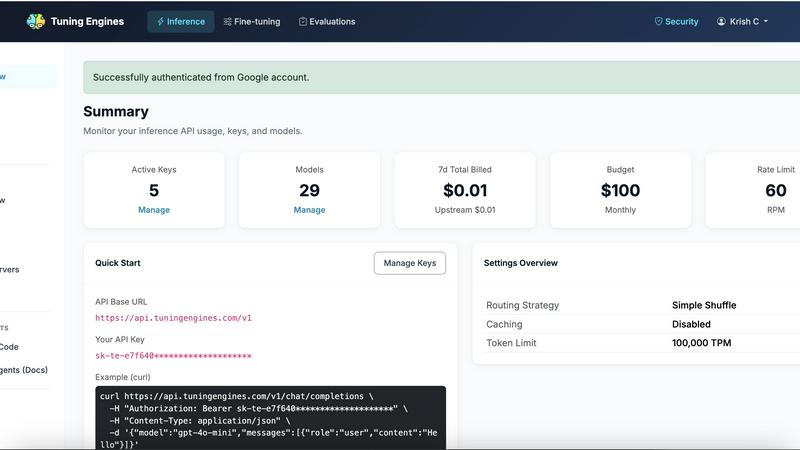
Tuning Engines lets you securely govern and optimize every AI interaction through a single API with zero markup on infrastructure costs.
About Tuning Engines
Tuning Engines is a unified AI control and governance layer designed for teams building production intelligence across models, agents, tools, and fine-tuned systems. At its core, this platform brings together the full AI lifecycle into one governed environment, enabling organizations to move beyond isolated AI experiments into a secure, observable, cost-aware, and extensible AI operating layer. The product serves both developers and administrators, providing a single point of control for inference, model routing, fallback policies, fine-tuning jobs, datasets, evaluations, model imports and exports, custom models, agents, and more. For developers, Tuning Engines offers OpenAI-compatible APIs, Anthropic-compatible routes, CLI workflows, MCP access, coding-agent integrations, and resource catalogs for models, agents, tools, and skills. This means teams can connect popular AI workflows like Claude Code, OpenCode, Aider, Cline, Roo, Continue.dev, Cursor, VS Code, and Windsurf through a single governed platform. For administrators, the platform delivers role-based access, per-key budgets, rate limits, routing profiles, fallback rules, guardrails, policy-as-code, credential sources, auditability, usage traces, billing controls, tenant isolation, and team management. What makes Tuning Engines particularly compelling is its unique pricing model: infrastructure costs are passed through at-cost with zero markup, meaning organizations only pay for support and platform upkeep. The platform is backed by major industry players including Google Cloud for Startups, NVIDIA Inception, Rogers Cybercatalyst, ElevenLabs Grants, AWS Activate, and BDC Capital, making it a trusted choice for production AI workloads.
Features of Tuning Engines
Unified Inference
One OpenAI-compatible endpoint serves as the gateway for open models, commercial frontier models, and your own tuned models. This means you keep your existing SDK and simply swap one base URL to access over 100 models with centralized policy, full auditability, and token controls applied to every request. No code rewrites, no new client to learn, just a single interface that handles streaming, structured output, and all standard API patterns.
Model Tuning
Adapt open models to your specific data, workflows, and production goals through supervised fine-tuning and LoRA adapters. The platform manages the entire tuning lifecycle, from dataset preparation to evaluation gates, ensuring quality moves with your business needs. You can train models without managing GPU infrastructure, and your tuned variants become available through the same unified API endpoint.
Evaluations
Measure quality, compare variants, and ship with evidence using built-in evaluation tools. The platform supports running evaluation gates as part of your tuning pipeline, so you can systematically compare model performance across different versions and configurations. This feature ensures that every model deployed to production has been vetted against your quality standards.
Policy and Governance
Centralized guardrails, access controls, and full request traceability operate across every model interaction. Administrators can define role-based access, per-key budgets, rate limits, routing profiles, fallback rules, and policy-as-code configurations. Every request carries audit trails, usage traces, and token economics data, making it easy to maintain compliance and control costs at scale.
Use Cases of Tuning Engines
Code Assistance
Build IDE copilots, code generation tools, refactoring agents, and debugging assistants that connect through a single governed API. Teams can integrate with popular coding environments like Cursor, VS Code, and Continue.dev, while administrators maintain control over which models are used, how tokens are consumed, and what policies apply to each developer interaction.
Conversational AI
Deploy customer support bots, internal helpdesks, and multilingual chat systems that leverage multiple models through intelligent routing and fallback policies. The platform enables teams to experiment with different models for different conversation types, apply guardrails for sensitive topics, and track every interaction for quality assurance and compliance purposes.
Agentic Systems
Build multi-step reasoning, planning, and tool-using execution pipelines that can access MCP servers, reusable skills, and custom tools through a governed runtime. Developers can create complex agent workflows that route between models, apply fallback policies when primary models fail, and maintain full observability into every reasoning step and tool call.
Enterprise RAG
Implement secure, scalable retrieval over knowledge bases and private documents with centralized policy controls. Teams can combine embedding models, language models, and retrieval systems through the unified API, while administrators enforce access controls, rate limits, and cost ceilings across the entire retrieval pipeline.
Frequently Asked Questions
What models are available through Tuning Engines?
The platform provides instant access to popular open weight models including Llama 3.3 70B, Llama 3.1 8B, DeepSeek V3, DeepSeek R1, Qwen 2.5 72B, Qwen 2.5 Coder 32B, Mistral Small 3, Mixtral 8x7B, Gemma 2 27B, Llama 3.2 Vision, Whisper Large v3, and various embedding models. Additionally, you can access commercial frontier models and any model you fine-tune with the platform, all through the same unified endpoint.
How does the pricing model work for Tuning Engines?
The platform operates on a unique pricing model where infrastructure costs are passed through at-cost with zero markup. This means you only pay for the actual compute and model usage costs, plus a separate fee for platform support and upkeep. There are no hidden margins on the underlying infrastructure, making the pricing transparent and cost-predictable.
Can I connect existing developer tools to Tuning Engines?
Yes, the platform offers OpenAI-compatible APIs that work with your existing SDK and tooling. You can connect Claude Code, OpenCode, Aider, Cline, Roo, Continue.dev, Cursor, VS Code, Windsurf, and other AI workflows through a single governed platform. The API is a drop-in replacement that requires only changing your base URL.
What administrative controls are available in the platform?
Administrators get comprehensive controls including role-based access management, per-key budgets, rate limits, routing profiles, fallback rules, guardrails, policy-as-code configurations, credential sources, auditability features, usage traces, billing controls, tenant isolation, and team management tools. This enables full governance over production AI workloads.
Similar to Tuning Engines


AutoGeo
A GEO SEO platform for creating, reviewing, publishing, and distributing multilingual content optimized for AI search visibility.

amaze.directory
A directory of AI tools where a person used each one first.

benchmark.directory
No sponsored listings, no affiliate ordering, no paid tier. 146 AI tools we bought, used, and reported on in public.

saasgrow.ai
No sponsored slots, no paid placement. Just SaaS growth tools that passed screening, sorted into categories you can browse.

Tools Network
New AI tools drop every day — Tools Network makes sure you never miss the ones that matter.

UseWok
Done-for-You SaaS Visibility for Search & AI | UseWok

Postqued
Schedule and publish social content across 10 platforms with one dashboard, API, and MCP built for teams and AI agents.