

SightRadar
SightRadar is a Rekognition-compatible face API for indexing, searching, comparing, and detecting faces, billed per photo processed.
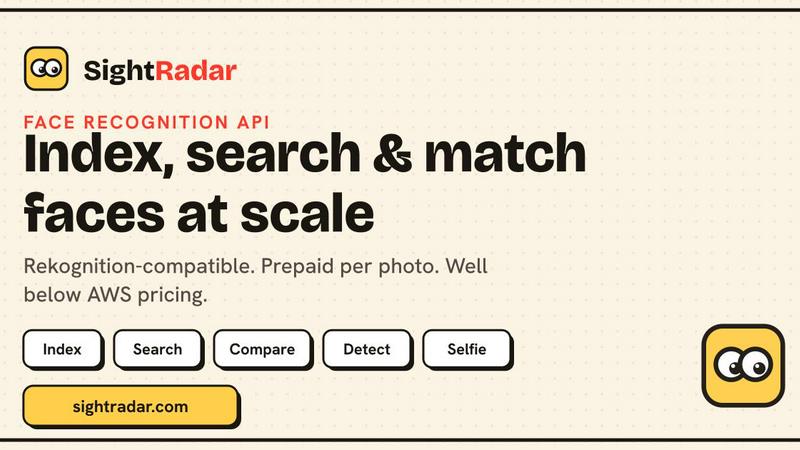
About SightRadar
SightRadar covers four face workflows through an API: index faces in a collection, search that collection from a face image, compare two faces, and detect faces without storing them. Search and comparison return scores teams can use to set their own thresholds. A zero-face photo is treated as a valid result, which can simplify pipelines that process mixed image collections.
The Python shim is aimed at teams already using boto3 with AWS Rekognition. It keeps familiar operation names and response shapes, with a client and import change described as the migration path. Developers using other languages can call the REST API. Official SDKs are listed for Python and Node/TypeScript.
Understand the retention boundary
Detection and comparison process photos in memory and do not persist them. Indexing stores face representations in collections, which can be deleted. This makes the choice of operation important: use indexing when later searches are needed, and choose detection or comparison for work that does not require a persistent face collection. SightRadar's terms require consent and a lawful basis for use.
Features of SightRadar
- Index and manage face collections, then search them by image or face ID.
- Compare faces and detect faces through separate API operations.
- Use a Python shim with Rekognition-style methods and response shapes.
- Submit images by URL, upload, or raw bytes; supported formats include JPEG, PNG, WebP, HEIC, TIFF, GIF, and BMP.
Use Cases of SightRadar
- Migrate a Python service that already calls Rekognition face operations.
- Process varied image formats in a face detection pipeline.
- Build gallery search that returns candidate matches with scores.
- Compare two submitted faces without retaining the photos.
Frequently Asked Questions
What does the Python shim preserve?
It uses familiar Rekognition method names, arguments, and response shapes for supported face operations. The migration guide describes changing the import and client setup.
Are zero-face photos errors?
No. The product describes a photo with zero detected faces as a valid, charged result.
What is stored after indexing?
Photos are not stored. Indexed faces are represented mathematically in a collection that can be deleted through the API or console.
Pricing of SightRadar
Usage-based pricing is billed per photo: $0.00062 for batch processing and $0.00093 for real-time processing. Stored face vectors cost $6 per million per month.
Explore more in this category:
Similar to SightRadar

MakePieces OfUs
MakePieces OfUs turns a pet photo into a private virtual room with free puzzles, an album and journal, plus optional daily stories and new places.

Drawcil
Drawcil turns a photo into a four-stage pencil lesson, helping beginners practise drawing on paper at their own pace.

GigUp
GigUp combines Upwork job matching with optional MCP and REST API access for freelancers who want matches in their own AI or software workflows.

Edit Image Text
Edit words in finished photos, screenshots, and graphics with AI, then compare the result against the original before downloading.

VirtualTryOn
Use AI photo try-on tools for clothing, glasses, rings and hair, with comparisons designed for visual exploration rather than measurement.

Safe Outreach
Safe Outreach checks Chrome extensions against LinkedIn's published detection list and explains what a match may mean for account risk.


RemoveObjectFromPhoto
Clean up photos in a browser by brushing over unwanted objects, people, or text and reviewing an AI-generated background fill.