
ScopeSnap vs Skene
Side-by-side comparison to help you choose the right AI tool.

ScopeSnap
Transform messy discovery notes into structured project scopes and polished proposals effortlessly with ScopeSnap's AI-driven platform.
Last updated: March 18, 2026

Skene transforms your codebase into a promptable growth engine you fully own.
Last updated: February 28, 2026
Visual Comparison
ScopeSnap
Skene
Feature Comparison
ScopeSnap
AI-Powered Backlog Generation
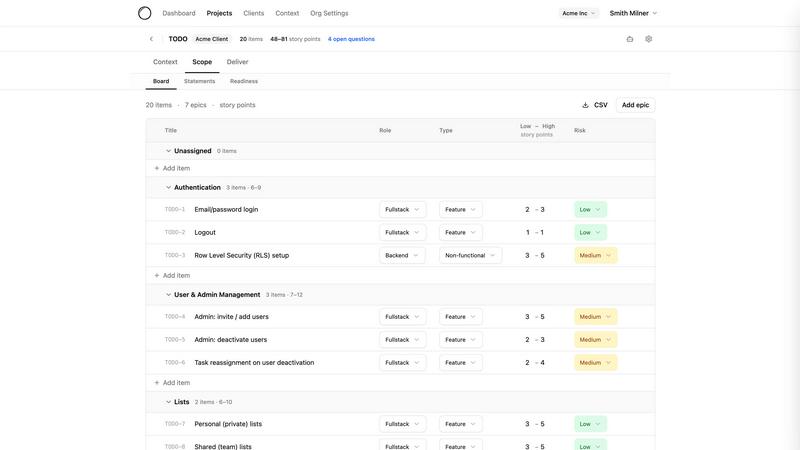
ScopeSnap harnesses the power of artificial intelligence to automatically generate a structured backlog from your discovery notes. This feature identifies epics and scope items, highlights open questions, and flags assumptions, making it easier for developers to visualize the project's requirements.
Contextual Input Integration
Easily paste in transcripts, emails, and notes from your discovery conversations into ScopeSnap. This contextual input allows for a comprehensive understanding of project requirements, ensuring all critical information is compiled in one accessible location, ready to be processed.
Iterative Refinement and Estimation
With ScopeSnap, users can iteratively refine the project scope by reviewing the structured backlog. Assign roles, set accurate estimates, and resolve any open questions in real-time, ensuring that every aspect of the project is well understood before moving forward.
Proposal and Statement of Work Generation
Once your project scope is clearly defined, ScopeSnap automatically generates a polished proposal or statement of work. This feature saves countless hours of manual writing, allowing you to deliver professional documentation directly to clients with a few clicks.
Skene
Codebase-Native Signal Detection
Skene integrates directly with your repository, performing a deep analysis of your source code to automatically detect growth signals. It scans your application's structure, understands user flows, and identifies key friction points and activation opportunities without you having to manually instrument events or define funnels. This creates a rich, contextual understanding of your product's growth potential derived from the very architecture of your software.
AI-Prompted Growth Implementation
Move beyond manual configuration. With Skene, you can instruct an AI agent to design and implement growth strategies using natural language prompts from your development environment. This allows you to rapidly prototype and deploy optimized onboarding sequences, lifecycle automations, and retention loops by simply describing the desired outcome, making sophisticated growth engineering accessible without requiring deep expertise.
Autonomous Iteration Engine
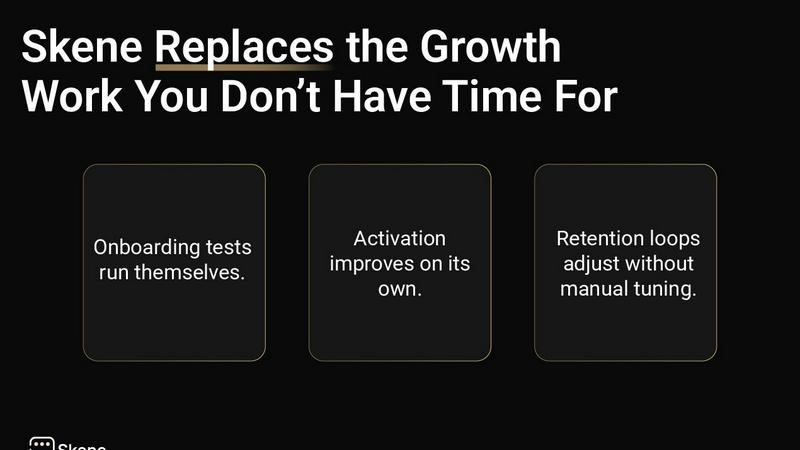
Skene operates as a continuous optimization layer. Once initial flows are established, the system autonomously runs experiments, analyzes user interaction data, and deploys improved versions of your growth loops. This creates a self-improving product where the mechanisms guiding user success evolve and refine themselves based on actual behavior, turning your app into a learning system.
Owned Growth Infrastructure
Replace brittle third-party scripts and black-box SaaS tools with code you own and control. Skene's framework integrates as a native part of your tech stack, ensuring your growth logic is version-controlled, performant, and modifiable. This eliminates data silos, preserves your application's performance, and allows your entire team—and your AI agents—to interact with and build upon your growth infrastructure.
Use Cases
ScopeSnap
Streamlining Discovery Calls
Freelance developers can utilize ScopeSnap to streamline the post-discovery process. By quickly transforming scattered notes into a structured format, developers can ensure that all important details are captured, leading to more accurate project scopes.
Enhancing Client Communication
Software agencies can enhance communication with clients by using ScopeSnap to create clear and concise proposals. This tool helps lay out project expectations and requirements clearly, reducing misunderstandings and ensuring alignment between developers and clients.
Improving Project Estimates
With ScopeSnap, freelance developers can provide more accurate estimates based on a well-defined project scope. By using the AI-generated backlog, they can identify potential pitfalls and ensure that no essential requirements are overlooked, ultimately leading to more successful projects.
Simplifying Collaboration Among Teams
For software agencies with multiple team members, ScopeSnap simplifies collaboration. Teams can collaboratively refine project scopes, assign tasks, and set estimates, all within a centralized platform, making project management smoother and more efficient.
Skene
Streamlining User Onboarding
For products struggling with low activation rates, Skene analyzes the signup and first-use journey directly from the code. It automatically identifies where users drop off and can generate, test, and deploy improved onboarding flows—like contextual guidance or progressive feature reveals—to dramatically increase the number of users who reach the "aha!" moment and realize core value.
Automating Customer Lifecycle Engagement
Instead of manually building email sequences or in-app messages, product teams can use Skene to create automated, behavior-triggered engagement loops. By understanding user actions from the codebase, Skene can prompt the implementation of nudges for feature adoption, re-engagement campaigns for inactive users, and success milestones that strengthen retention, all as native product experiences.
Optimizing for Product-Led Growth
Early-stage startups and indie developers can implement a sophisticated PLG motion without a large team. Skene acts as an automated growth co-pilot, handling the continuous cycle of identifying opportunities, hypothesizing improvements, and shipping experiments. This allows small teams to compete with the iterative power of much larger organizations by making data-driven optimization a core product function.
Reducing Friction in Key User Flows
For any application, pinpointing exactly where users encounter confusion or abandonment is challenging. Skene audits your code to visualize and understand critical user paths, such as checkout processes or complex feature workflows. It then suggests and can implement targeted optimizations to smooth out these journeys, directly improving conversion rates and user satisfaction.
Overview
About ScopeSnap
ScopeSnap is an innovative tool designed specifically for freelance developers and software agencies, transforming the chaotic world of discovery notes into structured and actionable project scopes. In the ever-evolving landscape of custom software development, estimating projects can often be a daunting task. Freelancers and agencies frequently find themselves sifting through disorganized notes, vague requirements, and the pressure of crafting accurate proposals. ScopeSnap alleviates these challenges by utilizing advanced AI technology to convert raw ideas into clear, estimatable tasks. From the initial discovery call through to a polished client-ready proposal or statement of work, ScopeSnap guides users through a streamlined process. This ensures that no critical detail is overlooked, empowering developers to deliver precise estimates and professional documentation with confidence. Built for those who regularly scope and estimate custom development projects, ScopeSnap is the ultimate solution to enhance productivity, reduce risk, and elevate client satisfaction.
About Skene
What if your product could learn to grow itself? Skene is an AI-powered PLG (Product-Led Growth) infrastructure that fundamentally reimagines how software scales. It moves growth from being an external, manual afterthought to a core, intelligent layer of your product itself. Designed for indie developers, early-stage startups, and product-led companies, Skene is a fully automated iteration engine that allows you to scale your user base without the need to scale a dedicated, costly growth team. Its revolutionary premise is simple yet powerful: growth should be code you own, version, and prompt—not a fragile third-party script you paste into your application. By connecting directly to your codebase and IDE, Skene analyzes your source to intuitively understand user flows, detect points of friction, and identify hidden activation opportunities. It then autonomously creates, tests, and deploys optimized versions of critical growth loops for onboarding, activation, and retention. This transforms your application into a self-optimizing engine for user success, where growth mechanisms improve continuously based on real user behavior. Instead of wrestling with complex dashboards and manual A/B tests, you can simply prompt your AI agent to implement sophisticated growth strategies, making high-level optimization accessible directly from your development environment.
Frequently Asked Questions
ScopeSnap FAQ
How does ScopeSnap help with project scoping?
ScopeSnap helps by converting messy discovery notes into structured project scopes, making it easier to identify and estimate tasks accurately.
Can I integrate my existing notes into ScopeSnap?
Yes, you can easily paste in transcripts, emails, and notes from your discovery conversations, allowing for a comprehensive overview of project requirements.
Is ScopeSnap suitable for solo freelancers and larger agencies?
Absolutely! ScopeSnap is designed for both individual freelancers and larger software agencies, catering to anyone who needs to scope and estimate custom development projects.
How quickly can I generate proposals with ScopeSnap?
Once your project scope is defined, ScopeSnap allows you to generate polished proposals or statements of work in just minutes, saving you valuable time and effort.
Skene FAQ
How is Skene different from traditional customer experience software?
Traditional tools like tour builders or analytics platforms require manual, brittle configuration on top of your UI. They often rely on CSS selectors that break with every code deploy and create siloed data. Skene is fundamentally different; it reads your actual codebase to understand your product's structure and automatically generates and maintains growth flows. When you update your code, Skene's understanding and implementations update in tandem, eliminating constant maintenance.
How long does it take to set up Skene?
Setup is designed to be incredibly fast, taking less than 60 seconds. You simply connect your GitHub or GitLab repository with read-only access. Skene then automatically analyzes your codebase to generate initial PLG insights and flows. No initial code changes or API modifications are required to get started and see value.
Is my source code secure with Skene?
Absolutely. Security is a primary concern. Skene only requires read-only access to your repository, meaning it cannot push or modify your code. All analysis occurs within a secure, isolated environment. Your proprietary code remains yours, and the growth logic Skene helps you build is deployed as code you own within your own infrastructure.
What kind of analytics and insights does Skene provide?
Skene offers a dashboard that provides real-time analytics on user progress, flow completion rates, and engagement metrics. It goes beyond surface-level data to identify specific bottlenecks in your journeys, track time-to-value, and measure the impact of each iterative change. This provides data-driven insights to continuously optimize your onboarding and growth loops.
Alternatives
ScopeSnap Alternatives
ScopeSnap is an innovative AI-driven tool designed to streamline project scoping and proposal creation for freelance developers and software agencies. By transforming disorganized discovery notes into structured project scopes and client-ready proposals, it significantly reduces the time and effort typically involved in estimating custom software projects. Users often seek alternatives to ScopeSnap for various reasons, including pricing considerations, specific feature requirements, or compatibility with their existing platforms. When searching for an alternative, it's essential to evaluate the tool's usability, the precision of its estimation capabilities, and how well it integrates with your current workflow to ensure it meets your unique project needs.
Skene Alternatives
Skene is an AI-powered product-led growth infrastructure, a category of tools designed to automate and optimize user acquisition and retention directly within your product. It works by integrating with your codebase to analyze user flows and autonomously test improvements, turning your application into a self-optimizing engine. Users often explore alternatives for various reasons. Some may seek a different pricing model or a more traditional, dashboard-driven analytics approach. Others might need a solution that integrates with a specific tech stack or offers a different balance between automation and manual control. The needs of a large enterprise can differ greatly from those of an indie developer. When evaluating options, consider how deeply the tool understands your product. Does it work with surface-level events or can it derive intent from your actual code? Look at the level of automation: does it just provide insights, or can it implement and test changes? Finally, assess ownership—is the growth logic embedded in your code, or is it dependent on an external, black-box service?