
LLMWise vs PoYo API
Side-by-side comparison to help you choose the right AI tool.

LLMWise
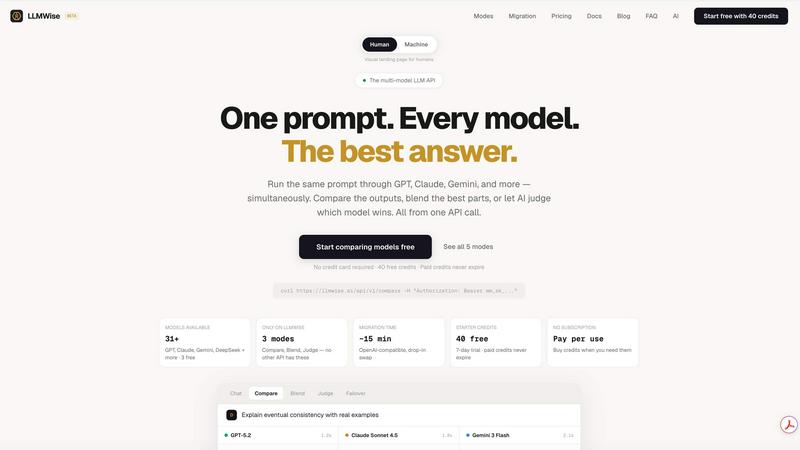
LLMWise simplifies AI access with one API for top models, auto-routing responses, and a pay-per-use pricing model.
Last updated: February 28, 2026

PoYo API
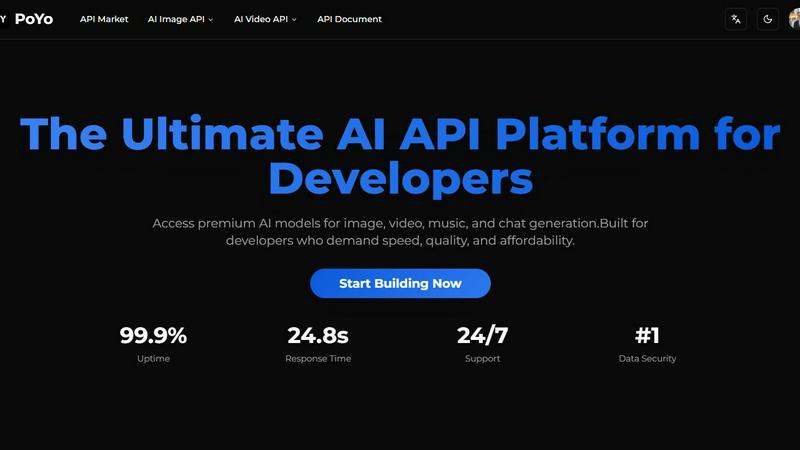
Discover premium AI models for image, video, music, and chat generation in one seamless API.
Last updated: February 28, 2026
Visual Comparison
LLMWise
PoYo API
Feature Comparison
LLMWise
Smart Routing
LLMWise's smart routing feature allows users to send prompts to the platform, which then intelligently selects the optimal model for the task at hand. For example, code-related queries can be directed to GPT, while creative writing tasks might be best suited for Claude. This ensures that every prompt is handled by the most capable model, maximizing efficiency and quality.
Compare & Blend
With the compare and blend functionalities, users can run prompts across multiple models side-by-side. This allows for direct comparison of responses, enabling users to choose the best output. The blend feature takes it a step further by combining the strengths of each model's response into one cohesive answer, enhancing the overall quality of the results.
Always Resilient
LLMWise is built with resilience in mind. The circuit-breaker failover system automatically reroutes requests to backup models if a primary provider experiences downtime. This means that applications using LLMWise remain operational, significantly reducing the risk of disruptions and ensuring constant availability.
Test & Optimize
Developers can take advantage of extensive benchmarking suites, batch tests, and optimization policies to refine their AI interactions. LLMWise offers tools for measuring performance based on speed, cost, or reliability, as well as automated regression checks to ensure consistent quality over time. This empowers users to continually optimize their usage of AI models.
PoYo API
Unified Multi-Model Access
Discover a vast, curated library of over 500 premium AI models through one simple integration. Instead of wrestling with different APIs for images, video, music, and chat, PoYo API provides a single endpoint and API key to access top-tier models like Sora-2, Veo3.1, GPT-4o, and the complete Suno music suite. This centralized access dramatically simplifies your tech stack and accelerates development, allowing you to focus on building innovative features rather than managing infrastructure.
Flexible Credit-Based Pricing
Embrace a truly pay-as-you-go model that aligns cost directly with your curiosity and usage. PoYo API operates on a credit system with no mandatory subscriptions or recurring monthly fees. You purchase credits that never expire and use them only when you generate content. This approach offers unparalleled financial flexibility, making it ideal for prototyping, scaling applications, or managing variable workloads without being locked into rigid plans.
Enterprise-Grade Reliability & Support
Build with confidence on a foundation designed for production. PoYo API guarantees a remarkable 99.9% uptime and offers ultra-low latency response times, often under 50ms, to handle high-concurrency demands. Your security is paramount, with encrypted API key storage and a zero-knowledge architecture. Furthermore, round-the-clock technical monitoring and dedicated human support ensure you have expert help available whenever your exploration hits a snag.
Developer-Centric Tools & Playground
Experiment and perfect your prompts before writing a single line of integration code. PoYo API provides free playground access on all model pages, allowing you to test parameters, debug responses, and fine-tune outputs at no cost. For integration, the platform offers a clean, asynchronous API design centered on two primary endpoints: submit a task and query results, often with webhook support for real-time callbacks, getting you from idea to implementation in minutes.
Use Cases
LLMWise
Software Development
In software development, LLMWise can be utilized to generate code snippets, debug existing code, or provide documentation. By leveraging the smart routing feature, developers can ensure that complex queries are directed to the most capable models, enhancing productivity and reducing errors.
Content Creation
For content creators, LLMWise offers a powerful tool for generating blogs, articles, or social media posts. The compare and blend features allow writers to experiment with different styles and tones, ultimately producing high-quality content that resonates with their audience.
Language Translation
LLMWise is an excellent choice for language translation tasks. By routing translation prompts to the most effective models, users can achieve precise translations that maintain the original meaning. This is especially useful for businesses operating in multiple languages.
AI Research
Researchers can utilize LLMWise to test hypotheses or analyze language models' responses across various AI systems. The testing and optimization features allow for systematic evaluation, providing insights into model performance and capabilities, which can drive innovation in AI research.
PoYo API
Dynamic Content Generation for Apps
Imagine empowering your social media platform, marketing tool, or game with on-demand, unique visual and audio content. Developers can integrate PoYo API to allow users to generate custom profile pictures, marketing banners, short video clips, or even theme music based on text prompts. This creates deeply engaging, personalized user experiences that keep audiences coming back to see what they can create next.
Rapid Prototyping for Startups
For startups and indie developers exploring AI-powered ideas, speed and cost are everything. PoYo API's unified access and credit-based model allow small teams to prototype multiple concepts—from an AI storytelling app with images and chat to a video snippet generator—without significant upfront investment. The free playground enables rapid iteration, helping validate product-market fit before committing to large-scale development.
Scalable Media Production for Agencies
Creative and marketing agencies can discover new efficiencies by leveraging AI for scalable content production. Using PoYo API, they can build internal tools to quickly generate mood board images, draft video storyboards with Sora-2, produce multiple versions of ad copy with chat models, or create custom audio jingles. This augments human creativity, accelerates project timelines, and allows for cost-effective A/B testing of visual and auditory concepts.
Building Specialized AI Assistants
Go beyond standard chatbots by creating sophisticated, multi-modal assistants. Integrate PoYo API's chat models with its image and music generation capabilities to build assistants that can not only converse but also create. For example, an educational assistant could generate diagrams to explain concepts, or a therapy bot could create calming soundscapes. This opens up a world of possibilities for more interactive and helpful AI companions.
Overview
About LLMWise
LLMWise is a revolutionary platform designed to simplify the way developers interact with multiple AI language models. By offering a single API that connects to major providers like OpenAI, Anthropic, Google, Meta, xAI, and DeepSeek, LLMWise eliminates the hassle of managing multiple AI subscriptions. Developers can seamlessly route their prompts to the most suitable model for each task, whether it is coding, creative writing, or translation. The intelligent routing feature ensures that every prompt is matched with the optimal model, enhancing efficiency and accuracy. Targeted towards developers who require the best AI solutions without the added complexity, LLMWise not only streamlines the process but also provides valuable tools for testing and optimizing AI performance. Its unique blend and compare features allow users to synthesize the best outputs from different models, ensuring high-quality results tailored to specific needs. Overall, LLMWise empowers developers to unleash the full potential of AI while minimizing costs and maximizing flexibility.
About PoYo API
What if you could unlock the creative potential of over 500 cutting-edge AI models through a single, streamlined gateway? PoYo API is that gateway, a revolutionary platform designed to satisfy the curiosity and ambition of developers building the next wave of intelligent applications. It centralizes premium AI capabilities for image, video, music, and chat generation, removing the complexity of managing multiple vendor APIs and subscriptions. Built with a developer-first mindset, it answers the critical demands for speed, exceptional output quality, and true cost efficiency. The platform's genius lies in its simplicity: one unified API key grants you access to a vast model library, from groundbreaking tools like Sora-2 for video and Nano Banana for images to advanced conversational models like GPT-4o. Coupled with a flexible, credit-based pricing model that eliminates recurring fees, PoYo API ensures you only pay for the compute you actually use. This empowers developers, startups, and enterprises to experiment freely and scale confidently, backed by enterprise-grade security, 99.9% uptime, and dedicated 24/7 support. PoYo API isn't just a tool; it's an invitation to explore and create without limits.
Frequently Asked Questions
LLMWise FAQ
How does LLMWise determine the optimal model for each prompt?
LLMWise employs intelligent routing algorithms that analyze the nature of the prompt and match it with the most suitable model based on its strengths and capabilities.
Can I use my existing API keys with LLMWise?
Yes, LLMWise supports the Bring Your Own Key (BYOK) feature, allowing users to integrate their existing API keys for various providers. This flexibility helps to reduce costs and streamline the integration process.
Is there a subscription fee for using LLMWise?
No, LLMWise operates on a pay-per-use model. Users only pay for the credits they consume, and there are no monthly subscription fees or recurring charges, making it a cost-effective solution.
How many models are available through LLMWise?
LLMWise provides access to over 62 models from 20 different providers, including both free and premium options. Users can experiment with 30 models at no cost, allowing for extensive testing and evaluation without financial commitment.
PoYo API FAQ
How does the credit-based pricing work?
With PoYo API, you purchase packs of credits upfront. Each AI model has a specific credit cost per use (e.g., an image generation might cost 5 credits). You only spend credits when you successfully generate content; failed tasks are not charged. There are no monthly subscriptions—your purchased credits sit in your account and never expire, giving you complete control over your spending and allowing you to scale usage up or down as needed.
Can I test the models before purchasing credits?
Absolutely! PoYo API encourages exploration with its free playground access. You can visit any model's page on the website, input your prompts, adjust parameters like style and dimensions, and generate sample outputs without spending any credits or even providing a credit card. This is the perfect way to experiment, compare different models, and ensure the AI's capabilities meet your specific needs before integrating the API into your application.
What kind of support is offered for integration?
PoYo API provides comprehensive support to get you building quickly. This includes detailed API documentation, code examples, and a simple two-endpoint async design for easy integration. Beyond self-service resources, their technical team offers dedicated 24/7 integration support. This means you can get help from real experts if you encounter issues with webhook setup, response handling, or optimizing your API calls for performance.
How does PoYo API ensure security and reliability?
Security and reliability are core pillars. Your API keys are encrypted using industry-standard practices. The platform boasts a 99.9% uptime SLA, backed by robust monitoring systems. It uses a zero-knowledge architecture where possible to protect your credentials and data. Additionally, the infrastructure is built for low latency and high concurrency, ensuring your applications remain responsive even under heavy load, making it a trustworthy foundation for production workloads.
Alternatives
LLMWise Alternatives
LLMWise is a versatile API platform that streamlines access to various large language models (LLMs) such as GPT, Claude, and Gemini, among others. By leveraging intelligent routing, it directs prompts to the most suitable model for each specific task, making it a powerful tool in the realm of AI Assistants. Users often seek alternatives due to factors such as pricing structures, feature sets, and specific platform requirements that may not align with their needs. When considering alternatives, it's essential to evaluate factors such as the variety of models offered, ease of integration, cost-effectiveness, and the flexibility to customize based on unique project demands. Additionally, understanding the support provided and the platform's reliability can greatly influence a user's decision in finding the right solution for their AI needs.
PoYo API Alternatives
PoYo API is a centralized platform in the AI Assistants category, providing developers seamless access to over 500 premium models for image, video, music, and chat generation. It's designed for those who value a unified interface, high performance, and a flexible, credit-based payment system. Developers often explore alternatives for various reasons. Some may seek a different pricing structure, such as a traditional subscription, or require access to a specific niche model not available on the platform. Others might prioritize different integration features, support tiers, or have unique compliance and security needs that drive their search. When evaluating other options, it's wise to consider the core pillars that make an API service effective. Look closely at the diversity and quality of the available AI models, the transparency and scalability of the pricing model, and the robustness of the platform's security and reliability guarantees. The goal is to find a solution that aligns perfectly with your project's technical requirements and growth trajectory.