
LLMWise vs Postproxy
Side-by-side comparison to help you choose the right AI tool.

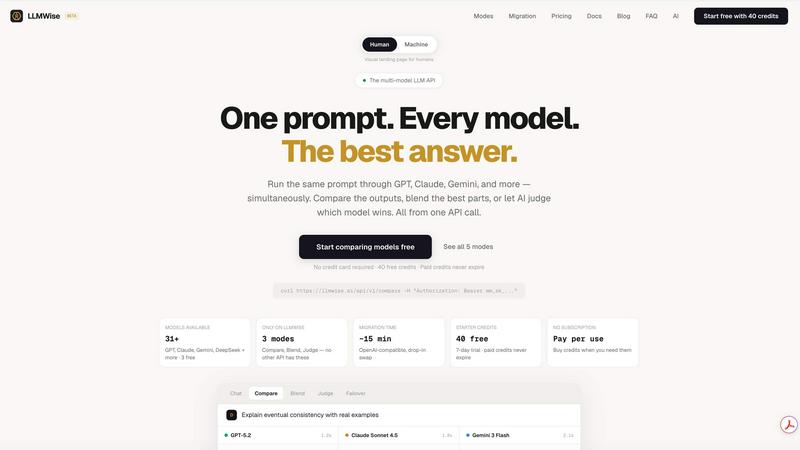
LLMWise simplifies AI access with one API for top models, auto-routing responses, and a pay-per-use pricing model.
Last updated: February 28, 2026

Postproxy
Discover how one API simplifies publishing to all your social networks.
Last updated: February 28, 2026
Visual Comparison
LLMWise
Postproxy
Feature Comparison
LLMWise
Smart Routing
LLMWise's smart routing feature allows users to send prompts to the platform, which then intelligently selects the optimal model for the task at hand. For example, code-related queries can be directed to GPT, while creative writing tasks might be best suited for Claude. This ensures that every prompt is handled by the most capable model, maximizing efficiency and quality.
Compare & Blend
With the compare and blend functionalities, users can run prompts across multiple models side-by-side. This allows for direct comparison of responses, enabling users to choose the best output. The blend feature takes it a step further by combining the strengths of each model's response into one cohesive answer, enhancing the overall quality of the results.
Always Resilient
LLMWise is built with resilience in mind. The circuit-breaker failover system automatically reroutes requests to backup models if a primary provider experiences downtime. This means that applications using LLMWise remain operational, significantly reducing the risk of disruptions and ensuring constant availability.
Test & Optimize
Developers can take advantage of extensive benchmarking suites, batch tests, and optimization policies to refine their AI interactions. LLMWise offers tools for measuring performance based on speed, cost, or reliability, as well as automated regression checks to ensure consistent quality over time. This empowers users to continually optimize their usage of AI models.
Postproxy
Unified Multi-Platform API
Imagine condensing the unique endpoints, authentication methods, and quirks of five major social networks into one consistent API call. Postproxy provides exactly that: a single POST request that intelligently routes and adapts your content to each specified platform. This eliminates the need to maintain separate SDKs or write custom integration code for Facebook, Instagram, and others, turning a complex web of APIs into one predictable interface for your publishing workflows.
Automated Platform Compliance & Adaptation
Each social network has its own secret language of rules—character limits, media formats, validation logic. Postproxy acts as a universal translator, automatically converting your content to match each platform's specific requirements. It handles the tedious normalization of AI-generated output, media formatting, and text validation behind the scenes, ensuring your post behaves correctly everywhere without manual tweaking.
Built-In Resilience and Delivery Guarantees
What happens when a platform API is flaky or you hit a rate limit? Instead of failing silently or requiring manual intervention, Postproxy is designed with operational resilience as a first-class feature. It manages automatic retries, respects and handles rate limits gracefully, maintains quota awareness, and provides explicit, clear reporting on publish states. You always know what succeeded, what failed, and why.
Centralized Authentication and Account Management
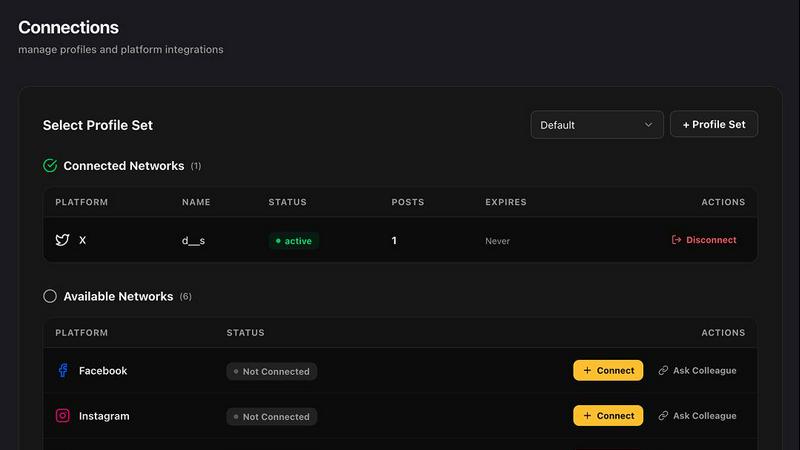
Navigating OAuth flows, token storage, and refresh cycles for multiple accounts and platforms is a significant overhead. Postproxy centralizes this complexity. You connect your social media accounts once, and it manages all platform permissions, secure token storage, and automatic token refreshes. This simplifies access control and eliminates the sprawl of managing credentials across dozens of pages or client accounts.
Use Cases
LLMWise
Software Development
In software development, LLMWise can be utilized to generate code snippets, debug existing code, or provide documentation. By leveraging the smart routing feature, developers can ensure that complex queries are directed to the most capable models, enhancing productivity and reducing errors.
Content Creation
For content creators, LLMWise offers a powerful tool for generating blogs, articles, or social media posts. The compare and blend features allow writers to experiment with different styles and tones, ultimately producing high-quality content that resonates with their audience.
Language Translation
LLMWise is an excellent choice for language translation tasks. By routing translation prompts to the most effective models, users can achieve precise translations that maintain the original meaning. This is especially useful for businesses operating in multiple languages.
AI Research
Researchers can utilize LLMWise to test hypotheses or analyze language models' responses across various AI systems. The testing and optimization features allow for systematic evaluation, providing insights into model performance and capabilities, which can drive innovation in AI research.
Postproxy
AI-Powered Content Automation Pipelines
You're using LLMs or AI agents to generate compelling social content, but the final publishing step breaks the automation. Postproxy seamlessly integrates into these pipelines, providing a reliable endpoint that accepts AI-generated content, adapts it for each platform, and executes the publish command. This closes the loop, creating a fully automated content creation-to-publication system without manual formatting or platform-specific debugging.
Multi-Client Social Media Management Tools
Agencies and SaaS tools managing social media for multiple clients face immense complexity with account permissions and platform integrations. Postproxy simplifies this by acting as a unified backend. It allows you to manage connections for all client accounts in one place and publish to any combination of them through a single, stable API, drastically reducing development and maintenance overhead.
Event-Driven and Scheduled Publishing Workflows
For teams using automation platforms like n8n, Zapier, or Make, Postproxy becomes the crucial publishing module. Whether triggered by a new blog post (webhook), a scheduled time, or a database update, these workflows can now push content to social networks reliably. Postproxy handles the execution, retries, and status reporting, making these automations truly robust and hands-off.
Large-Scale Campaign and Product Launch Coordination
Launching a coordinated campaign across multiple social channels at a specific time is high-stakes. Postproxy provides the determinism needed for scale. You can queue thousands of posts, and the platform will manage the delivery, respecting platform quotas and limits, while giving you a clear, centralized view of the entire campaign's publish status, ensuring nothing gets lost or fails silently.
Overview
About LLMWise
LLMWise is a revolutionary platform designed to simplify the way developers interact with multiple AI language models. By offering a single API that connects to major providers like OpenAI, Anthropic, Google, Meta, xAI, and DeepSeek, LLMWise eliminates the hassle of managing multiple AI subscriptions. Developers can seamlessly route their prompts to the most suitable model for each task, whether it is coding, creative writing, or translation. The intelligent routing feature ensures that every prompt is matched with the optimal model, enhancing efficiency and accuracy. Targeted towards developers who require the best AI solutions without the added complexity, LLMWise not only streamlines the process but also provides valuable tools for testing and optimizing AI performance. Its unique blend and compare features allow users to synthesize the best outputs from different models, ensuring high-quality results tailored to specific needs. Overall, LLMWise empowers developers to unleash the full potential of AI while minimizing costs and maximizing flexibility.
About Postproxy
What if publishing to social media could be as reliable and predictable as sending an email? Postproxy is an exploration into turning that idea into reality. It's a unified API layer designed to transform the chaotic, fragmented process of multi-platform social media publishing into a stable piece of infrastructure. At its core, Postproxy acts as a single, intelligent endpoint that sits between your application and the ever-shifting APIs of platforms like Instagram, Facebook, YouTube, LinkedIn, and X. It's built for developers, automators, and teams who are tired of the hidden complexities—the platform bureaucracy, inconsistent rules, account sprawl, and operational failures that only reveal themselves at the worst possible moment. By abstracting away the need for platform-specific integrations, OAuth flows, rate limit handling, and content adaptation, Postproxy offers a consistent and reliable publishing contract. This allows you to focus on creating and routing content, whether it's generated by LLMs, triggered by CI/CD pipelines, or orchestrated in tools like n8n and Zapier, with the confidence that the "last mile" of delivery is handled with deterministic logic and clear reporting.
Frequently Asked Questions
LLMWise FAQ
How does LLMWise determine the optimal model for each prompt?
LLMWise employs intelligent routing algorithms that analyze the nature of the prompt and match it with the most suitable model based on its strengths and capabilities.
Can I use my existing API keys with LLMWise?
Yes, LLMWise supports the Bring Your Own Key (BYOK) feature, allowing users to integrate their existing API keys for various providers. This flexibility helps to reduce costs and streamline the integration process.
Is there a subscription fee for using LLMWise?
No, LLMWise operates on a pay-per-use model. Users only pay for the credits they consume, and there are no monthly subscription fees or recurring charges, making it a cost-effective solution.
How many models are available through LLMWise?
LLMWise provides access to over 62 models from 20 different providers, including both free and premium options. Users can experiment with 30 models at no cost, allowing for extensive testing and evaluation without financial commitment.
Postproxy FAQ
What social media platforms does Postproxy support?
Postproxy currently provides a unified API for publishing to Instagram, Facebook, YouTube, LinkedIn, and X (formerly Twitter). The platform handles the unique API logic, content rules, and authentication requirements for each of these networks automatically, so you don't have to.
How does Postproxy handle platform API changes or failures?
A core value of Postproxy is maintaining a stable contract with its users. When social platforms update their APIs or experience outages, the Postproxy team manages the necessary adaptations on their side. Your integration remains unchanged. Furthermore, its built-in systems automatically retry failed publishes (where appropriate) and handle rate limits, insulating your workflows from common platform instability.
Is Postproxy suitable for publishing from LLM or AI-generated content?
Absolutely. This is a primary use case. Postproxy excels at taking raw, AI-generated output and automatically adapting it to meet the specific format, length, and media requirements of each target social platform. It turns the often-manual final step of formatting AI content into a fully automated process within your pipeline.
What does "explicit publish states" mean?
Unlike many direct API integrations where a post can silently fail or drop, Postproxy provides clear, deterministic feedback for every publish attempt. You will receive explicit status indicating success, failure, or queuing, along with reasons for any failures (e.g., "rate limit exceeded," "media format invalid"). This eliminates the need for manual checking and guesswork.
Alternatives
LLMWise Alternatives
LLMWise is a versatile API platform that streamlines access to various large language models (LLMs) such as GPT, Claude, and Gemini, among others. By leveraging intelligent routing, it directs prompts to the most suitable model for each specific task, making it a powerful tool in the realm of AI Assistants. Users often seek alternatives due to factors such as pricing structures, feature sets, and specific platform requirements that may not align with their needs. When considering alternatives, it's essential to evaluate factors such as the variety of models offered, ease of integration, cost-effectiveness, and the flexibility to customize based on unique project demands. Additionally, understanding the support provided and the platform's reliability can greatly influence a user's decision in finding the right solution for their AI needs.
Postproxy Alternatives
Postproxy is a developer-centric tool in the social media automation category. It provides a single, unified API to publish content across major platforms like Instagram, Facebook, YouTube, LinkedIn, and X. This approach handles the complex backend work—OAuth, rate limits, and content formatting—so developers can focus on building their applications. Even with its robust offering, users often explore alternatives for various reasons. Needs can differ based on budget, with some requiring a different pricing model or a free tier with specific limits. Others might need support for niche social networks not covered or seek a different user experience, such as a full graphical dashboard instead of a primarily API-driven service. When evaluating other options, consider your core requirements. Key factors include the specific social platforms you need to support, the importance of API reliability and detailed analytics, and how the tool integrates into your existing workflow, whether that's through no-code platforms, custom code, or AI pipelines. The goal is to find a solution that turns social publishing from a chore into a seamless, automated part of your process.