
JSON to Video vs Renderly
Side-by-side comparison to help you choose the right AI tool.

JSON to Video
Discover how structured JSON prompts unlock predictable, cinematic videos in just sixty seconds.
Last updated: March 1, 2026

Renderly
Discover how Renderly transforms code into thousands of personalized videos at enterprise scale.
Last updated: February 28, 2026
Visual Comparison
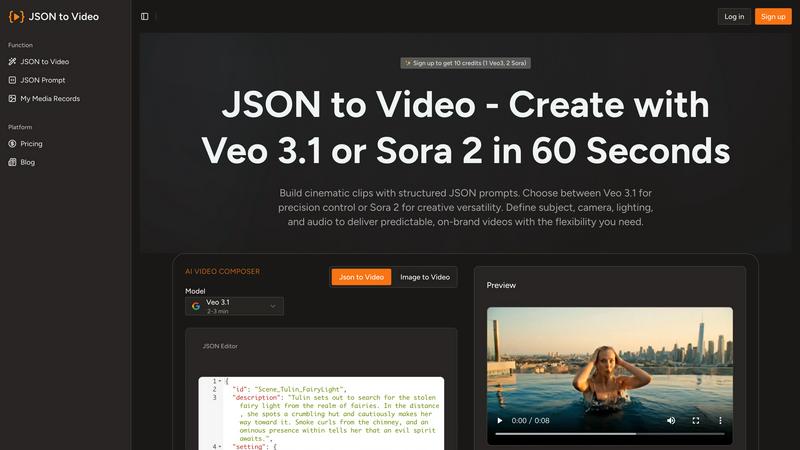
JSON to Video
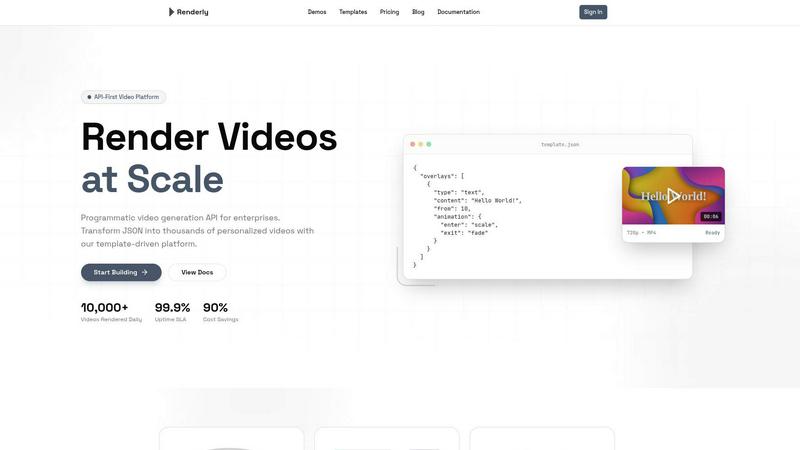
Renderly
Feature Comparison
JSON to Video
Structured JSON Schema for Precision
The cornerstone of JSON to Video is its comprehensive JSON schema, which acts as a blueprint for your video. Each field corresponds to a specific visual or auditory parameter, allowing you to define elements like shot composition, camera movement, subject description, wardrobe, scene location, and audio mix with incredible detail. This structure eliminates the ambiguity of traditional text prompts, ensuring the AI model interprets your creative direction accurately and consistently, leading to predictable and high-quality outputs every time.
Multi-Model Support (Veo 3.1, Seedance 2, etc.)
The platform offers the flexibility to leverage the unique strengths of multiple state-of-the-art generative video models. You are not locked into a single AI's interpretation. Whether you need the cinematic quality of Veo 3.1, the dynamic motion of Seedance 2, or the capabilities of Wan 2.6 and Kling 2.6, you can choose the best tool for your specific project. This allows for exploratory creativity, letting you see how different models render the same structured prompt.
Detailed Cinematic Control
Go beyond basic subject matter. The schema provides granular control over true cinematic elements. You can specify the lens type (e.g., "35mm with cinematic softness"), frame rate, camera movements like "smooth slider pans," intricate lighting setups, and a detailed color palette. This level of control empowers users to craft videos with a specific tone and professional aesthetic, making it feel less like AI generation and more like digital filmmaking.
Integrated Audio and Timeline Specification
JSON to Video understands that sound is half the experience. The schema includes dedicated audio sections for music, ambient sound, and sound effects, complete with mix levels. Furthermore, the timeline array allows you to break down the video sequence by seconds, describing the action and visual progression moment-by-moment. This feature is perfect for storyboarding complex narratives and ensuring the audio-visual elements are perfectly synchronized from start to finish.
Renderly
Programmatic Video Generation API
The heart of Renderly is its robust, RESTful API that allows developers to generate videos entirely through code. You can trigger video renders, check job statuses, and manage workflows programmatically. This API-first design means you can integrate dynamic video creation directly into your applications, CRMs, or data pipelines. It supports webhooks for asynchronous processing and comes with comprehensive SDKs, making it seamless to embed powerful video generation capabilities into any tech stack, from a simple web app to a complex enterprise system.
JSON-Configurable Template System
Renderly uses a powerful template system where video designs are defined and controlled using JSON configuration. Developers and designers can create a master template with placeholder variables for text, images, and other assets. Then, for each render, you simply pass a unique JSON object to the API, and Renderly swaps in the content to produce a distinct video. This allows for incredible flexibility and dynamic content generation, enabling the creation of thousands of personalized videos from a single template design.
Enterprise-Grade Scalable Infrastructure
Built on a cloud-native platform, Renderly's infrastructure is engineered for high-volume workloads. It features auto-scaling capabilities that automatically handle spikes in demand, whether you're rendering one video or one hundred thousand concurrently. This ensures consistent performance and reliability, backed by a 99.9% uptime SLA. You never have to worry about provisioning servers or managing rendering queues; the platform scales effortlessly with your business needs.
Transparent Credit-Based Pricing
Renderly operates on a transparent, pay-per-render credit system. This model means you only pay for the video seconds you actually generate, leading to potential savings of up to 90% compared to fixed-fee or subscription-based competitors. The pricing is designed to be clear, with volume discounts available for high-throughput enterprise customers. This approach provides cost predictability and aligns expenses directly with usage and value.
Use Cases
JSON to Video
Branded Marketing and Advertisement Clips
Marketers can produce on-brand video content with remarkable consistency. By codifying brand guidelines—such as color palettes, lighting moods, and character styles—into a JSON template, teams can generate countless ad variations, product showcases, or social media clips that all maintain perfect brand alignment. This allows for rapid A/B testing of different scenarios while ensuring visual coherence across an entire campaign.
Narrative Short Film and Storyboarding
Independent filmmakers and writers can use the platform as a dynamic storyboarding tool. The structured prompt allows for pre-visualizing complex scenes, experimenting with different cinematography choices, and understanding the flow of a narrative before live production. It’s a sandbox for visualizing script elements, from character actions and props to camera angles and environmental transitions, bringing written stories to life quickly.
Educational and Explainer Content
Educators and instructional designers can create engaging explainer videos with clear, consistent visual metaphors. By structuring the lesson into a timeline with defined scenes and subjects, complex topics can be broken down into digestible, visually compelling segments. The predictable output ensures that key educational elements are always presented clearly, enhancing learning retention.
Product Visualization and Prototyping
Designers and architects can visualize products or spaces in cinematic environments. Imagine showcasing a new piece of furniture or a room layout through a curated video sequence, with controlled lighting to highlight features and specific camera movements to guide the viewer's eye. This use case transforms static designs into immersive experiences, ideal for client presentations and concept validation.
Renderly
Personalized Marketing & Sales Videos
Imagine sending a video email where the recipient's name, company logo, and a specific product offer are seamlessly integrated into the footage. Renderly enables the mass generation of hyper-personalized video content for sales outreach, onboarding sequences, and customer win-backs. By pulling data from a CRM, each customer receives a unique video that feels individually crafted, dramatically increasing engagement and conversion rates at scale.
Automated Social Media Content Creation
For brands and agencies managing multiple social channels, creating fresh, platform-specific content is a constant challenge. Renderly can automate the production of bulk social media videos. A template can be designed for Instagram Stories, TikTok clips, or LinkedIn ads, and then populated with daily trending topics, new product features, or user-generated content feeds, outputting hundreds of formatted videos ready for publishing without manual editing.
Data-Driven Reporting & Visualization
Transform dry spreadsheets and analytics dashboards into engaging video summaries. Renderly can pull data from business intelligence tools to generate weekly performance reports, animated KPI summaries, or investor updates. Charts, graphs, and key metrics are brought to life with motion graphics, making complex data easily digestible and shareable in a compelling video format that static reports cannot match.
E-learning & Dynamic Training Materials
Educational platforms and corporate training programs can use Renderly to create customized learning modules. A single course template can be dynamically populated with different case studies, learner names, or region-specific information. This allows for scalable production of tailored training videos, certification summaries, or interactive educational content that adapts to the viewer, enhancing the learning experience.
Overview
About JSON to Video
What if you could direct an AI video model with the precision of a film director, not the guesswork of a prompt engineer? JSON to Video is a groundbreaking platform that unlocks this exact possibility. It transforms the often-frustrating process of text-to-video generation into a structured, predictable, and deeply creative workflow. By using a detailed JSON schema instead of ambiguous text prompts, you gain meticulous control over every cinematic element. Imagine filling out a digital storyboard where you can specify the exact subject, camera movements, lens type, lighting conditions, color grading, soundtrack, and even subtle sound effects. This platform is specifically engineered to interpret your structured data payload and translate it faithfully into high-quality video clips using cutting-edge models like Veo 3.1, Seedance 2, Wan 2.6, and Kling 2.6. It's designed for creators, marketers, educators, and brands who are curious about AI video but demand reliability and alignment with their vision. The core value proposition is profound: replace randomness with repeatability, and transform structured data into stunning, cinematic scenes in as little as 60 seconds. It invites you to explore a new language of visual creation, one where your intent is clearly understood and executed.
About Renderly
What if you could generate a video as easily as you generate a PDF? Renderly is a video infrastructure platform that makes this vision a reality, transforming the complex, manual process of video rendering into a simple, automated API call. At its core, Renderly is a programmatic video generation platform designed for developers and creators who need to produce video content at scale. It serves a fascinating niche, bridging the gap between dynamic data and compelling visual storytelling. Imagine feeding a JSON payload with text, images, and data points into an API and receiving a fully rendered, personalized video in return. This is the powerful automation Renderly provides. It's built for enterprises, marketing teams, and software developers who are bogged down by the limitations of manual video editing or the complexities of building in-house rendering solutions. The main value proposition is clear: unprecedented scalability, significant cost reduction (up to 90% compared to competitors), and a developer-first experience. By offering a template-driven system where videos are defined by configurable JSON, Renderly empowers businesses to create thousands of unique videos for use cases like personalized marketing campaigns, data-driven reports, bulk social media content, and dynamic motion graphics, all without ever opening a traditional video editor.
Frequently Asked Questions
JSON to Video FAQ
What is the main advantage of using JSON over a text prompt?
The main advantage is precision and predictability. A text prompt like "a person in a room" is open to vast interpretation by an AI. A JSON schema allows you to specify that the person is an "adult in simple, clean clothing," the room is a "modern living room with ambient shelves," the camera uses a "35mm lens," and the movement is a "smooth slider pan." This structured approach drastically reduces guesswork and ensures the output closely matches your detailed vision.
Do I need to be a programmer to use JSON to Video?
Not at all. While familiarity with JSON's basic structure (key-value pairs in braces) is helpful, the platform is designed to be accessible. The website provides clear templates and examples for various genres (Action, Ad, Narrative, etc.) that you can copy and modify. You simply fill in the values for each field, much like completing a detailed form, without needing to write complex code from scratch.
Which AI video models does JSON to Video support?
The platform supports several leading generative video models, including Google's Veo 3.1, Kuaishou's Seedance 2, as well as Wan 2.6 and Kling 2.6. This multi-model approach gives you creative flexibility, allowing you to select the model that best suits the style or motion requirements of your specific project, all within the same structured prompting interface.
Can I control the audio and sound design?
Yes, audio control is a core feature. The JSON schema includes a dedicated "audio" section where you can describe the music style (e.g., "soft, ascending ambient pad"), ambient sounds, specific sound effects, and their mix levels. This allows for the creation of a cohesive audio-visual experience, where the soundtrack and effects are integral to the scene's mood and action, not an afterthought.
Renderly FAQ
What kind of inputs does the Renderly API accept?
The Renderly API primarily accepts JSON payloads that define the video to be rendered. This JSON references a pre-built template and provides the dynamic variables for that specific render, such as text strings, image URLs, colors, and timing information. You can also manage assets through the platform. The API is designed to be flexible, allowing you to trigger renders from any system that can send an HTTP POST request with the correct data structure.
How does the template system work for creating videos?
Templates are the blueprints for your videos. You first design a video composition using Renderly's online tools or by defining its structure in JSON. This template includes layers for text, images, videos, and shapes, along with their animations and timing. Placeholder variables are set within this template. When you call the render API, you provide a data object that fills these placeholders, generating a unique video. This separates design from data, enabling mass personalization.
Is Renderly suitable for real-time or live video generation?
Renderly is optimized for asynchronous, on-demand video generation rather than real-time streaming. The rendering process, while fast, takes time to process frames and encode the final video file. It's perfect for use cases where videos are generated in response to an event (like a user action or a data update) and then delivered via a link or download shortly after, such as for personalized welcome videos or automated report generation.
What measures are in place for security and reliability?
Renderly is built as an enterprise-grade platform with a strong focus on security and reliability. The infrastructure boasts a 99.9% uptime SLA. From a security perspective, it features SOC 2 compliance, data encryption in transit and at rest, strict access controls, and comprehensive audit logging. This ensures that your video data and rendering jobs are handled with the highest standards of operational security and availability.
Alternatives
JSON to Video Alternatives
JSON to Video is a specialized tool in the generative AI video space, allowing creators to build cinematic scenes using structured JSON data instead of ambiguous text prompts. This approach offers a unique blend of creative control and predictable output, setting it apart from more conventional video generation platforms. Users often explore alternatives for various reasons. Some may seek different pricing models or free tiers to experiment with. Others might need compatibility with specific platforms or workflows, or desire a different balance between ease of use and granular creative control. The search for the right tool is a natural part of finding the perfect fit for one's project needs and technical comfort. When evaluating other options, consider the core trade-off between flexibility and predictability. Look at how much direct control you have over visual elements like camera work and lighting versus the simplicity of a text-only interface. Also, assess the output quality, supported formats, and how well the tool integrates into your existing content creation pipeline. The goal is to find a solution that aligns with both your creative vision and practical requirements.
Renderly Alternatives
Renderly is a video infrastructure platform in the automation and programmatic video generation category. It empowers users to create thousands of videos through code, an API, or an online editor, moving beyond manual rendering for personalized content and data-driven motion graphics. Users often explore alternatives for various reasons. These can include budget constraints, the need for different feature sets like more advanced editing or specific integrations, or simply a preference for a different user experience or platform ecosystem. The search for the right tool is a natural part of finding the perfect workflow fit. When evaluating alternatives, consider your core needs. Key factors often include the primary use case, such as social media clips versus complex data visualizations, the importance of API depth versus a no-code interface, scalability for large batches, and of course, the overall pricing structure that aligns with your project volume.