
dmaya vs Postproxy
Side-by-side comparison to help you choose the right AI tool.

dmaya
dMaya is an AI design platform that streamlines UI creation, client collaboration, and code export for teams and agencies.
Last updated: April 13, 2026

Postproxy
Discover how one API simplifies publishing to all your social networks.
Last updated: February 28, 2026
Visual Comparison
dmaya
Postproxy
Feature Comparison
dmaya
AI-Powered Design Generation
dMaya leverages advanced AI technology to convert plain language descriptions into intricate, production-ready UI designs within moments. This feature eliminates lengthy design processes, enabling teams to focus on creativity rather than technicalities.
Multi-Screen Canvas
The platform offers an infinite canvas where users can simultaneously work on desktop and mobile frames. This feature enhances productivity by allowing drag-and-drop functionality, zooming, and organization, similar to Figma, but with the added efficiency of AI assistance.
Built for Teams & Collaboration
Designed with teamwork in mind, dMaya allows users to invite team members, share projects with clients, and leave comments in real-time. Role-based access ensures that everyone involved can contribute effectively while maintaining focus on their specific tasks.
Client Presentation Mode
With dMaya’s interactive preview feature, users can share polished designs with clients through a single, account-free link. This facilitates immediate feedback collection and iteration, streamlining the approval process and making it easier to align with client expectations.
Postproxy
Unified Multi-Platform API
Imagine condensing the unique endpoints, authentication methods, and quirks of five major social networks into one consistent API call. Postproxy provides exactly that: a single POST request that intelligently routes and adapts your content to each specified platform. This eliminates the need to maintain separate SDKs or write custom integration code for Facebook, Instagram, and others, turning a complex web of APIs into one predictable interface for your publishing workflows.
Automated Platform Compliance & Adaptation
Each social network has its own secret language of rules—character limits, media formats, validation logic. Postproxy acts as a universal translator, automatically converting your content to match each platform's specific requirements. It handles the tedious normalization of AI-generated output, media formatting, and text validation behind the scenes, ensuring your post behaves correctly everywhere without manual tweaking.
Built-In Resilience and Delivery Guarantees
What happens when a platform API is flaky or you hit a rate limit? Instead of failing silently or requiring manual intervention, Postproxy is designed with operational resilience as a first-class feature. It manages automatic retries, respects and handles rate limits gracefully, maintains quota awareness, and provides explicit, clear reporting on publish states. You always know what succeeded, what failed, and why.
Centralized Authentication and Account Management
Navigating OAuth flows, token storage, and refresh cycles for multiple accounts and platforms is a significant overhead. Postproxy centralizes this complexity. You connect your social media accounts once, and it manages all platform permissions, secure token storage, and automatic token refreshes. This simplifies access control and eliminates the sprawl of managing credentials across dozens of pages or client accounts.
Use Cases
dmaya
Agencies
Agencies can leverage dMaya to generate design concepts quickly during discovery calls, significantly enhancing their pitch processes. By presenting multiple design directions in just hours, they can win more clients and streamline their workflow.
Product Teams
Product teams benefit from dMaya by exploring various UI directions before committing engineering resources. This allows for enhanced collaboration across design, product, and engineering disciplines, reducing the discrepancies between designed output and actual builds.
Freelancers
Freelancers can utilize dMaya to expand their project capacity without extending their working hours. By generating high-quality designs swiftly, they can manage more clients simultaneously, thus increasing their revenue potential.
Startups
Startups can capitalize on dMaya's rapid design capabilities to iterate on their product ideas quickly. With the ability to present concepts to stakeholders and gather feedback without delays, startups can pivot and adapt their offerings based on real-time insights.
Postproxy
AI-Powered Content Automation Pipelines
You're using LLMs or AI agents to generate compelling social content, but the final publishing step breaks the automation. Postproxy seamlessly integrates into these pipelines, providing a reliable endpoint that accepts AI-generated content, adapts it for each platform, and executes the publish command. This closes the loop, creating a fully automated content creation-to-publication system without manual formatting or platform-specific debugging.
Multi-Client Social Media Management Tools
Agencies and SaaS tools managing social media for multiple clients face immense complexity with account permissions and platform integrations. Postproxy simplifies this by acting as a unified backend. It allows you to manage connections for all client accounts in one place and publish to any combination of them through a single, stable API, drastically reducing development and maintenance overhead.
Event-Driven and Scheduled Publishing Workflows
For teams using automation platforms like n8n, Zapier, or Make, Postproxy becomes the crucial publishing module. Whether triggered by a new blog post (webhook), a scheduled time, or a database update, these workflows can now push content to social networks reliably. Postproxy handles the execution, retries, and status reporting, making these automations truly robust and hands-off.
Large-Scale Campaign and Product Launch Coordination
Launching a coordinated campaign across multiple social channels at a specific time is high-stakes. Postproxy provides the determinism needed for scale. You can queue thousands of posts, and the platform will manage the delivery, respecting platform quotas and limits, while giving you a clear, centralized view of the entire campaign's publish status, ensuring nothing gets lost or fails silently.
Overview
About dmaya
dMaya is a revolutionary design platform specifically crafted for agencies, teams, and freelancers who prioritize visual design before diving into code. It empowers users to generate professional-quality UI designs from simple text descriptions, allowing for a seamless transition from concept to execution. With dMaya, you can describe your project, whether it's a SaaS dashboard, an e-commerce flow, or a mobile app, and receive polished screens in mere seconds. The platform stands out by facilitating iterative conversations with an AI agent, enabling instant adjustments to colors, layouts, typography, and sections. This design-first approach ensures that teams can catch potential issues early, align collaboratively, and secure client approvals rapidly. With its design tokens feature, consistency across all screens is maintained effortlessly. Once designs are finalized, users can export them as clean HTML, CSS, and JavaScript code, ready to be handed off to any coding agent like Cursor or Claude Code for development in frameworks such as React or Flutter. This unique workflow allows teams to present confidently, approve efficiently, and ship products faster than ever.
About Postproxy
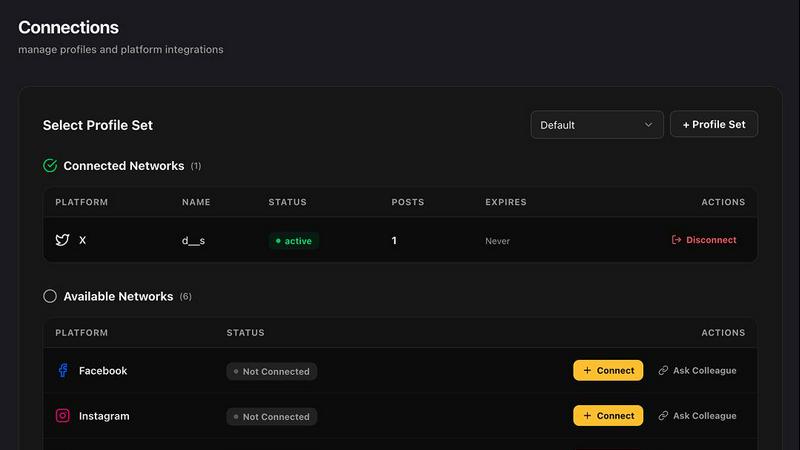
What if publishing to social media could be as reliable and predictable as sending an email? Postproxy is an exploration into turning that idea into reality. It's a unified API layer designed to transform the chaotic, fragmented process of multi-platform social media publishing into a stable piece of infrastructure. At its core, Postproxy acts as a single, intelligent endpoint that sits between your application and the ever-shifting APIs of platforms like Instagram, Facebook, YouTube, LinkedIn, and X. It's built for developers, automators, and teams who are tired of the hidden complexities—the platform bureaucracy, inconsistent rules, account sprawl, and operational failures that only reveal themselves at the worst possible moment. By abstracting away the need for platform-specific integrations, OAuth flows, rate limit handling, and content adaptation, Postproxy offers a consistent and reliable publishing contract. This allows you to focus on creating and routing content, whether it's generated by LLMs, triggered by CI/CD pipelines, or orchestrated in tools like n8n and Zapier, with the confidence that the "last mile" of delivery is handled with deterministic logic and clear reporting.
Frequently Asked Questions
dmaya FAQ
How does dMaya generate designs from text descriptions?
dMaya employs sophisticated AI algorithms that interpret your plain language descriptions and translate them into comprehensive, production-ready UI designs almost instantaneously. This allows for a streamlined design process.
Can I collaborate with team members in dMaya?
Yes, dMaya is built for collaboration. You can invite team members to your projects, share designs for feedback, and even leave comments, facilitating a more integrated workflow that enhances team productivity.
What happens after I get client approval?
Once you receive client approval on your designs, you can easily export them as clean code in HTML, CSS, and JavaScript formats. This code can then be handed off to any coding agent for further development in your chosen framework.
Is there a limit to the number of screens I can design at once?
No, dMaya provides an infinite canvas that allows you to work on multiple screens across different devices simultaneously. This flexibility enhances your design capabilities and supports comprehensive project development.
Postproxy FAQ
What social media platforms does Postproxy support?
Postproxy currently provides a unified API for publishing to Instagram, Facebook, YouTube, LinkedIn, and X (formerly Twitter). The platform handles the unique API logic, content rules, and authentication requirements for each of these networks automatically, so you don't have to.
How does Postproxy handle platform API changes or failures?
A core value of Postproxy is maintaining a stable contract with its users. When social platforms update their APIs or experience outages, the Postproxy team manages the necessary adaptations on their side. Your integration remains unchanged. Furthermore, its built-in systems automatically retry failed publishes (where appropriate) and handle rate limits, insulating your workflows from common platform instability.
Is Postproxy suitable for publishing from LLM or AI-generated content?
Absolutely. This is a primary use case. Postproxy excels at taking raw, AI-generated output and automatically adapting it to meet the specific format, length, and media requirements of each target social platform. It turns the often-manual final step of formatting AI content into a fully automated process within your pipeline.
What does "explicit publish states" mean?
Unlike many direct API integrations where a post can silently fail or drop, Postproxy provides clear, deterministic feedback for every publish attempt. You will receive explicit status indicating success, failure, or queuing, along with reasons for any failures (e.g., "rate limit exceeded," "media format invalid"). This eliminates the need for manual checking and guesswork.
Alternatives
dmaya Alternatives
dMaya is an innovative AI vibe design platform tailored for agencies, teams, and freelancers who seek to streamline the design phase before diving into coding. By utilizing AI to generate professional UI designs from simple text descriptions, dMaya enables users to create polished screens quickly and efficiently. This unique approach not only enhances collaboration but also allows for rapid iteration and feedback, making it an indispensable tool for modern design workflows. Users often explore alternatives when they encounter limitations in pricing, feature sets, or platform compatibility. The need for a solution that better fits their specific requirements can arise from various factors such as budget constraints, desired functionalities, or the desire for a more intuitive user experience. When considering alternatives, it's essential to evaluate the features that matter most to your team, including ease of use, collaboration capabilities, and the ability to export designs seamlessly into code.
Postproxy Alternatives
Postproxy is a developer-centric tool in the social media automation category. It provides a single, unified API to publish content across major platforms like Instagram, Facebook, YouTube, LinkedIn, and X. This approach handles the complex backend work—OAuth, rate limits, and content formatting—so developers can focus on building their applications. Even with its robust offering, users often explore alternatives for various reasons. Needs can differ based on budget, with some requiring a different pricing model or a free tier with specific limits. Others might need support for niche social networks not covered or seek a different user experience, such as a full graphical dashboard instead of a primarily API-driven service. When evaluating other options, consider your core requirements. Key factors include the specific social platforms you need to support, the importance of API reliability and detailed analytics, and how the tool integrates into your existing workflow, whether that's through no-code platforms, custom code, or AI pipelines. The goal is to find a solution that turns social publishing from a chore into a seamless, automated part of your process.