
diffray vs Fallom
Side-by-side comparison to help you choose the right AI tool.

diffray
Unlock superior code quality with diffray's intelligent AI review that detects real bugs and reduces false alarms.
Last updated: February 28, 2026

Fallom offers real-time observability for your AI agents, providing complete visibility and cost tracking.
Last updated: February 28, 2026
Visual Comparison
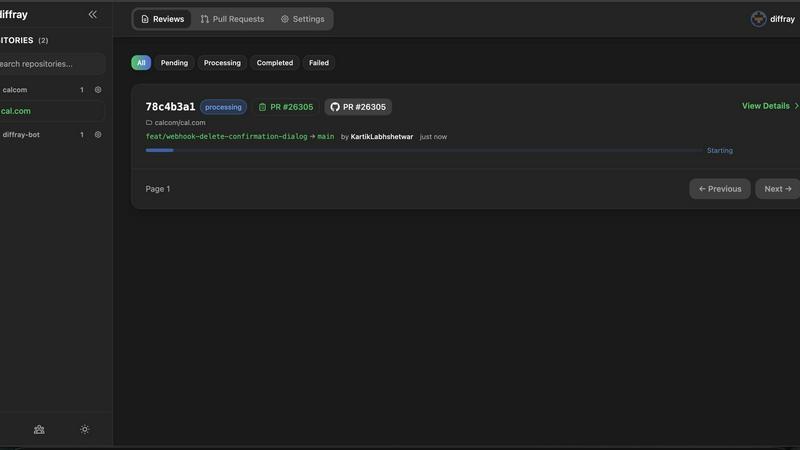
diffray
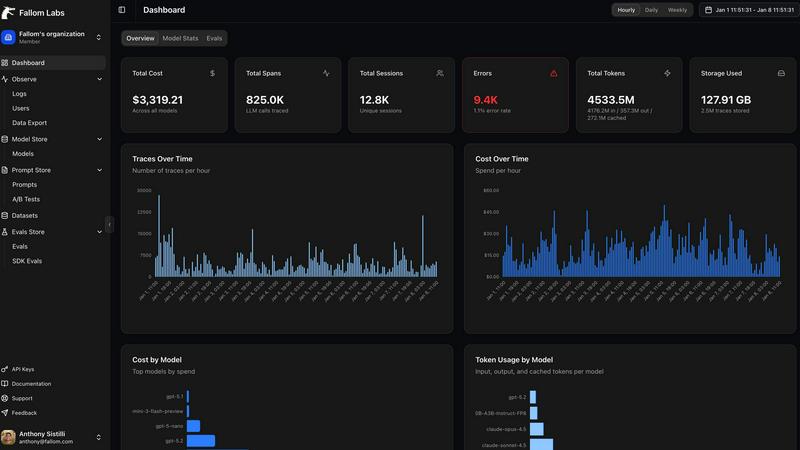
Fallom
Feature Comparison
diffray
Multi-Agent Architecture
diffray employs a unique multi-agent architecture that harnesses the power of over 30 specialized agents. Each agent is finely tuned to focus on distinct aspects of code review such as security, performance, and best practices. This ensures that feedback is relevant and targeted, reducing the noise often associated with traditional code review tools.
Contextual Feedback
One of the standout features of diffray is its ability to provide contextual feedback based on the specific codebase being analyzed. This means that the insights generated are not only precise but also actionable, allowing developers to understand the nuances of their code and implement improvements effectively.
Reduced Review Times
With diffray, teams experience a significant drop in PR review times. By streamlining the code review process and minimizing unnecessary distractions, developers can focus on what truly matters: enhancing their code and delivering quality software efficiently.
Enhanced Detection of Issues
The specialized agents within diffray excel at identifying a range of potential issues, including bugs, security vulnerabilities, and performance bottlenecks. This advanced detection capability empowers developers to proactively address problems before they escalate, fostering a culture of quality and safety in software development.
Fallom
End-to-End LLM Tracing
Dive deep into the complete lifecycle of every AI interaction. Fallom automatically captures and visualizes the entire chain of events, from the initial user prompt through each sequential LLM call, tool invocation, and final response. You can explore crucial details like the exact inputs and outputs, token consumption, latency breakdowns, and the associated cost for each step. This granular, waterfall-style visibility is fundamental for understanding agent behavior, identifying bottlenecks, and ensuring the quality of complex, multi-step workflows.
Granular Cost Attribution & Analytics
Ever wondered exactly which model, team, or customer is driving your AI spend? Fallom brings complete financial transparency to your LLM operations. It automatically attributes costs down to the individual call level, allowing you to break down expenses by model provider, specific user, internal team, or even end customer. This enables precise budgeting, accurate chargebacks, and data-driven decisions about model selection, helping you optimize for both performance and cost-efficiency without any financial blind spots.
Enterprise Compliance & Audit Trails
Navigate the evolving landscape of AI regulation with built-in confidence. Fallom is engineered for regulated industries, providing immutable, comprehensive audit trails of all AI interactions. This includes full input/output logging, model version tracking, and user consent recording—features essential for meeting standards like GDPR, SOC 2, and the EU AI Act. Its configurable privacy modes also allow you to redact sensitive data or log only metadata, ensuring compliance without sacrificing essential observability.
Real-Time Dashboard & Live Monitoring
Watch your AI systems operate in real-time with a dynamic, interactive dashboard. See live traces stream in, monitor overall system health, and spot anomalies in usage patterns, latency, or error rates as they happen. This immediate visibility allows teams to proactively identify and troubleshoot issues before they impact users, turning reactive firefighting into proactive system management and ensuring high reliability for your AI-powered applications.
Use Cases
diffray
Accelerated Code Reviews
Development teams can leverage diffray to accelerate their code review processes significantly. By providing tailored feedback and reducing false positives, developers can review PRs more quickly and efficiently, allowing for faster delivery cycles.
Improved Code Quality
diffray aids teams in enhancing their overall code quality by identifying issues that might otherwise go unnoticed. This leads to cleaner, more maintainable code and helps prevent technical debt from accumulating over time.
Security Enhancements
Security is paramount in software development, and diffray addresses this need effectively. By utilizing its specialized agents focused on security vulnerabilities, teams can ensure that their code is resilient against potential threats and adheres to best practices.
Continuous Learning and Improvement
By consistently using diffray, development teams foster a culture of continuous learning. The actionable insights provided by the tool help developers refine their skills and understanding of best practices, leading to ongoing improvement in their coding abilities.
Fallom
Debugging Complex AI Agent Workflows
When a customer-facing agent fails to book a flight correctly, traditional logging offers only fragments of the story. Fallom allows developers to replay the entire agent session, examining the exact prompts, the data returned from each tool call (like flight search APIs), and the LLM's reasoning at each step. This complete context transforms debugging from a guessing game into a precise, efficient process, dramatically reducing mean time to resolution for intricate AI issues.
Implementing Transparent AI Cost Management
For a SaaS company embedding AI features, uncontrolled costs can quickly derail profitability. Fallom enables finance and engineering leaders to see precisely how much each product feature, customer segment, or internal project is spending on AI. This allows for accurate showback/chargeback models, informed decisions on pricing tiers, and identification of optimization opportunities, such as switching to a more cost-effective model for certain tasks without degrading user experience.
Ensuring Regulatory Compliance for AI Deployments
A healthcare or financial services firm deploying AI assistants must demonstrate strict adherence to data privacy and operational transparency regulations. Fallom provides the verifiable audit trail required, logging every interaction with user context, model versions used, and data processed. Its privacy controls ensure sensitive information can be protected, giving compliance officers the evidence needed to pass audits and build trust with users and regulators.
Optimizing Model Performance & A/B Testing
Choosing the right LLM is critical for application quality and cost. Fallom facilitates robust A/B testing by allowing teams to safely split traffic between different models or prompt versions. You can then compare their performance in real-time across key metrics like accuracy, latency, and cost per call directly within the platform. This data-driven approach takes the guesswork out of model selection and prompt engineering, ensuring you confidently deploy the best-performing configuration.
Overview
About diffray
diffray is a groundbreaking AI code review tool that aims to revolutionize the code review process for development teams. Unlike traditional AI solutions that often rely on a one-size-fits-all approach, diffray utilizes an innovative multi-agent architecture comprised of over 30 specialized agents. Each agent is meticulously designed to focus on specific areas of code evaluation, such as security vulnerabilities, performance optimization, bug detection, and adherence to best practices. This targeted approach minimizes irrelevant feedback and significantly increases the likelihood of identifying genuine issues within the code. As a result, development teams using diffray have reported dramatic reductions in pull request (PR) review times alongside a notable decrease in false positives, making it an invaluable tool for software developers and engineering teams. The core value proposition of diffray lies in its ability to deliver precise and actionable feedback tailored to the unique context of each codebase. This ultimately enhances the development workflow and elevates code quality, paving the way for more efficient and effective software creation.
About Fallom
What if you could peer inside the intricate conversations of your AI agents, understanding not just their final answers but the entire journey of thought, tool use, and decision-making? Fallom is the key to that exploration. It is a cutting-edge, AI-native observability platform built from the ground up for the unique complexities of Large Language Model (LLM) and autonomous agent workloads. Designed for engineering teams and organizations scaling their AI applications, Fallom provides a comprehensive, real-time window into every AI interaction happening in production. Its core value lies in transforming opaque AI operations into transparent, analyzable, and optimizable processes. With a simple OpenTelemetry-native SDK, you can instantly trace every LLM call, capturing a rich tapestry of data including prompts, outputs, token usage, latency, costs, and the precise sequence of tool calls. This isn't just monitoring; it's about gaining profound, contextual insights. By grouping traces by user, session, or customer, Fallom helps you understand not just what your AI is doing, but who it's for and why it matters. Built with enterprise-scale compliance in mind, it offers the robust audit trails and model governance needed to navigate regulatory landscapes like the EU AI Act. Fallom empowers you to debug with confidence, allocate costs with precision, and ultimately build more reliable, efficient, and transparent AI systems.
Frequently Asked Questions
diffray FAQ
How does diffray improve the code review process?
diffray enhances the code review process by employing a multi-agent architecture that delivers precise, contextual feedback tailored to the specific codebase, thereby reducing noise and increasing the likelihood of identifying real issues.
Can diffray integrate with existing development workflows?
Yes, diffray is designed to seamlessly integrate into existing development workflows, making it easy for teams to adopt without disrupting their current processes.
What types of issues can diffray detect?
diffray specializes in detecting a wide range of issues, including security vulnerabilities, performance bottlenecks, bugs, and adherence to coding best practices, ensuring comprehensive code quality assessments.
Is diffray suitable for all programming languages?
While diffray is optimized for a variety of programming languages, its effectiveness may vary based on the specific language and the complexity of the codebase. It is advisable to review the supported languages on the diffray website for more details.
Fallom FAQ
How does Fallom integrate with my existing application?
Fallom is built on the open standard OpenTelemetry (OTEL), making integration remarkably straightforward. You simply install a single, lightweight SDK into your application code. This SDK automatically instruments your LLM calls—whether you use OpenAI, Anthropic, Google, or other providers—and sends the rich tracing data to the Fallom platform. This means no vendor lock-in and a setup process that can be completed in under five minutes, with no changes to your core application logic.
Can Fallom handle sensitive or private data?
Absolutely. Fallom is designed with enterprise-grade security and privacy controls. It offers a configurable "Privacy Mode" where you can choose to redact specific data fields, log only transaction metadata (like timestamps and token counts), or disable content capture entirely for sensitive environments. This allows you to maintain full observability over system performance and costs while ensuring user data and confidential information are protected according to your policies.
What makes Fallom different from traditional APM tools?
Traditional Application Performance Monitoring (APM) tools are built for conventional software, struggling to interpret the non-deterministic, language-heavy nature of LLM operations. Fallom is AI-native, meaning it understands concepts unique to this domain: it traces semantic prompts and completions, visualizes tool-call sequences, attributes costs per token, and evaluates output quality. It provides the specific context and metrics that AI engineers need, which generic APM tools simply cannot surface.
How does Fallom help with testing and quality assurance?
Fallom includes capabilities for running evaluations on your LLM outputs. You can define custom checks for accuracy, relevance, hallucination rates, or other metrics and run them against sampled or all production traces. This allows you to catch regressions in model performance or prompt effectiveness before they widely impact users. Coupled with its Prompt Store for versioning and A/B testing, it creates a robust framework for continuous improvement of your AI's quality.
Alternatives
diffray Alternatives
diffray is an innovative AI code review tool that enhances code quality by utilizing a unique multi-agent architecture. This category of software is essential for development teams looking to streamline their pull request processes and improve the overall efficiency of code reviews. Users often seek alternatives to diffray due to factors such as pricing, specific feature requirements, or compatibility with their existing platforms. When choosing an alternative, it’s essential to evaluate the technology's ability to provide relevant and actionable feedback while also considering integration capabilities, user experience, and support for team workflows. A well-suited alternative should align with the specific needs of your development process, ensuring that it enhances productivity without introducing unnecessary complexity.
Fallom Alternatives
Fallom is a specialized observability platform for AI development, focusing on the unique challenges of monitoring Large Language Model and agent-based applications. It provides deep visibility into prompts, costs, and performance, helping teams build reliable and transparent AI systems. Developers and organizations often explore alternatives for various reasons. They might be seeking a different pricing model, a platform that integrates more tightly with their existing infrastructure, or a solution with a broader or narrower feature scope that better matches their specific stage of AI adoption. When evaluating other tools in this space, consider your core needs. Look for robust tracing capabilities, granular cost attribution, and compliance features if required. The ease of instrumentation and the depth of context provided for each AI interaction are also key factors that determine how effectively you can debug, optimize, and govern your LLM workloads.