
Agent to Agent Testing Platform vs Project20x
Side-by-side comparison to help you choose the right AI tool.

Agent to Agent Testing Platform
Validate and enhance AI agents across chat and voice platforms, ensuring compliance and performance through.
Last updated: February 28, 2026

Project20x
Discover how AI governance ensures your policies are both compliant and future-ready.
Last updated: March 4, 2026
Visual Comparison
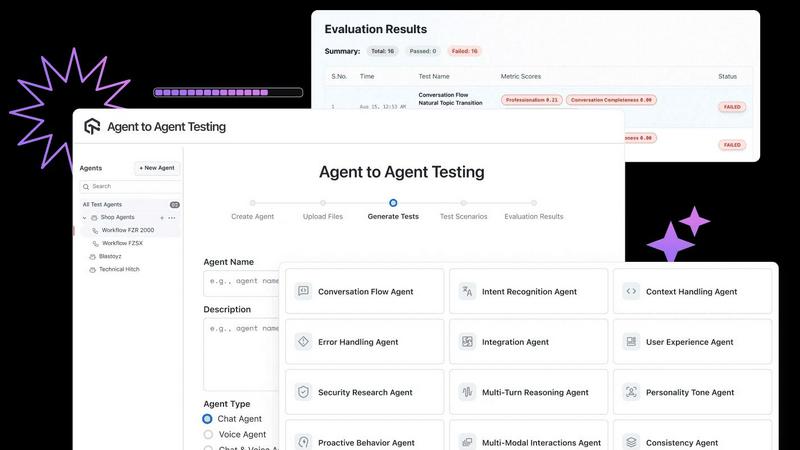
Agent to Agent Testing Platform
Project20x
Feature Comparison
Agent to Agent Testing Platform
Automated Scenario Generation
The platform utilizes advanced algorithms to create diverse test scenarios that simulate real-world interactions across chat, voice, and phone modalities. This feature ensures that AI agents are tested under a variety of conditions, capturing a broad spectrum of potential user interactions.
True Multi-Modal Understanding
Agent to Agent Testing Platform goes beyond simple text evaluation, allowing users to input various data types such as images, audio, and video. This capability enables a comprehensive assessment of AI agents, ensuring they perform effectively across all interaction modes and accurately reflect real-world conditions.
Autonomous Test Scenario Generation
With access to a library of hundreds of pre-defined scenarios or the ability to create custom ones, users can evaluate AI agents on specific traits such as personality tone, data privacy, and intent recognition. This feature helps in thoroughly judging the agent's performance in a controlled yet realistic setting.
Diverse Persona Testing
This feature allows testers to simulate interactions using various user personas, such as an International Caller or a Digital Novice. By employing diverse personas, enterprises can ensure that their AI agents cater effectively to a wide range of user needs and behaviors, making them more universally applicable.
Project20x
The Governance Layer
This is where sound policy begins. Imagine an AI co-pilot for lawmakers. The Governance Layer employs a sophisticated ten-step AI methodology to analyze draft legislation. It probes for clarity, identifies potential internal conflicts or gaps, and assesses alignment with existing legal frameworks. This process acts as a powerful pre-emptive tool, helping to craft robust, coherent policies from the outset by surfacing issues that human reviewers might overlook, thereby strengthening the foundational documents of public administration.
The Management Layer (Rules as Code)
Here, policy transforms into practice. Once a policy is approved, the Management Layer automatically translates its text into executable code through a "Rules as Code" paradigm. This turns static legal documents into dynamic, logical workflows that can automate complex governmental processes. It ensures that the intent of the law is preserved in its digital implementation, reducing manual interpretation errors and creating a backbone of efficient, consistent, and automated operations for agency staff.
The Citizen Interface Layer
This is the public face of the new government. The Interface Layer provides citizens with 24/7 access to AI agents that are expertly trained on the codified policies from the Management Layer. Whether applying for a permit, checking benefit eligibility, or understanding a new regulation, individuals can interact with a knowledgeable, always-available assistant. This demystifies public services, streamlines interactions, and delivers personalized guidance, making government help truly accessible anytime, anywhere.
Transparency & Audit Engine
Baked into the core of Project20x is an unwavering commitment to oversight. Every automated decision, policy translation, and citizen interaction is logged, creating a comprehensive and immutable audit trail. This engine ensures all governmental activities are quantifiable and traceable back to their source policy. Crucially, it is designed for rigorous human oversight, allowing auditors and officials to monitor, review, and intervene in AI-driven processes, maintaining accountability and building public trust in the system.
Use Cases
Agent to Agent Testing Platform
Quality Assurance for AI Chatbots
Enterprises deploying chatbots can use this platform to ensure their AI agents handle conversations effectively, maintaining accuracy and relevance in responses while adhering to company policies and user expectations.
Voice Assistant Optimization
Organizations can leverage the testing framework to validate voice assistants, ensuring they understand and respond to user queries accurately. This is crucial for enhancing user experience and reducing frustration caused by misinterpretations.
Phone Caller Agent Testing
For businesses utilizing AI-driven phone agents, the platform provides rigorous testing to assess their performance in real-time conversations. This ensures that the agents can manage calls efficiently and maintain professionalism throughout interactions.
Continuous Improvement of AI Systems
The platform allows for ongoing evaluation of AI agents even after deployment. By conducting regular regression testing and risk scoring, organizations can uncover potential issues and prioritize critical updates, ensuring their AI systems remain effective and reliable over time.
Project20x
Legislative Drafting and Analysis
Lawmakers and legislative aides can use the Governance Layer as a collaborative drafting tool. By inputting early policy concepts, they can receive AI-generated analysis on potential unintended consequences, statutory conflicts, and clarity issues. This allows for iterative refinement before a bill is even introduced, leading to more effective legislation and reducing the time spent on remedial fixes later in the political process.
Automated Permit and License Processing
A city planning department can implement Project20x to handle building permit applications. The Management Layer codifies zoning laws and building codes, creating an automated workflow that instantly checks an application for compliance. The citizen-facing AI agent can then guide an applicant through the process, request specific documents, and provide real-time status updates, dramatically reducing processing times from weeks to hours or days.
Dynamic Public Benefit Eligibility
State social service agencies can deploy the platform to manage benefit programs like SNAP or unemployment insurance. The system's codified rules can automatically cross-reference applicant data with ever-changing eligibility criteria. This allows for immediate, accurate preliminary assessments, freeing caseworkers to handle complex exceptions and provide human-centric support, while ensuring citizens get clear, instant answers about their status.
Public Policy Simulation and Engagement
Before enacting a new regulation, a government body can use Project20x to create a simulated interface for public feedback. Citizens can interact with an AI agent trained on the proposed rule to understand its practical impact on them. This exploratory tool fosters more informed public commentary and allows agencies to gather data on potential pain points or confusion, leading to policies that are better understood and more widely accepted.
Overview
About Agent to Agent Testing Platform
Agent to Agent Testing Platform is an innovative AI-native quality assurance framework meticulously designed to validate the behavior of AI agents in real-world scenarios. As AI systems increasingly operate autonomously and unpredictably, traditional quality assurance methods fall short, highlighting the need for a more robust solution. This platform transcends basic prompt-level checks, enabling comprehensive evaluation of multi-turn conversations across diverse modalities such as chat, voice, and phone interactions. It serves enterprises aiming to ensure their AI agents are reliable and effective before deployment. By leveraging a dedicated assurance layer, the platform generates tests using over 17 specialized AI agents, designed to identify long-tail failures, edge cases, and interaction patterns that manual testing might miss. The result is a powerful, autonomous testing environment that simulates thousands of user interactions, providing actionable insights into key performance metrics and ensuring a smooth rollout of AI agents.
About Project20x
What if government could be as intuitive and responsive as your favorite app? Project20x is an ambitious exploration into that very possibility. It's an AI-native platform designed to fundamentally reimagine how governments operate, transforming dense, often inaccessible regulatory frameworks into dynamic, user-friendly digital processes. This isn't just about digitizing forms; it's about translating the very language of law and policy into a functional, living system. The platform is built for a new era of governance, serving lawmakers who craft policy, agencies that implement it, and citizens who interact with it daily. Its core mission is to dissolve the traditional barriers between policy creation and public engagement, fostering a more transparent, efficient, and accountable relationship between the state and its people. By structuring itself into three intelligent layers—Governance, Management, and Interface—Project20x creates a seamless pipeline from legislative intent to automated public service, ensuring every action is traceable and every rule is actionable.
Frequently Asked Questions
Agent to Agent Testing Platform FAQ
What types of AI agents can be tested using this platform?
The Agent to Agent Testing Platform can test various AI agents, including chatbots, voice assistants, and phone caller agents, across multiple interaction scenarios.
How does the platform ensure comprehensive testing?
The platform employs automated scenario generation and diverse persona testing to simulate a wide range of user interactions, ensuring that AI agents are evaluated thoroughly and effectively.
Can I create custom test scenarios?
Yes, users have the ability to create custom scenarios tailored to their specific needs, in addition to accessing a library of pre-defined testing scenarios.
What key metrics can be evaluated during testing?
The platform assesses a range of metrics, including bias, toxicity, hallucinations, effectiveness, accuracy, empathy, and professionalism, providing detailed insights into the performance of AI agents.
Project20x FAQ
How does Project20x ensure the AI doesn't make biased or incorrect decisions?
Project20x is built on a principle of "human-in-the-loop" oversight. The AI does not autonomously create policy; it assists in its analysis and execution. The Rules as Code translation is based explicitly on the human-written legal text. Furthermore, the comprehensive Transparency & Audit Engine allows every automated outcome to be reviewed and challenged. The system is designed to flag uncertainties for human review, ensuring AI is a tool for consistency and scale, not an unchecked authority.
Is my data secure when interacting with a government AI agent on Project20x?
Security and privacy are foundational to the platform's architecture. All citizen interactions are handled with the same stringent data protection standards expected of government IT systems. The platform is designed to comply with regulations like FISMA. Data usage is transparently governed by the codified policies it runs on, and you can learn more about specific data practices, like cookie usage for site analytics, through dedicated policy pages as noted in the provided context.
Can Project20x work with a government's existing legacy computer systems?
Yes, a key design consideration is interoperability. The Management Layer, which generates the "Rules as Code," is built to integrate with existing government databases and case management systems through secure APIs. Think of Project20x as a new, intelligent nervous system that can connect to and coordinate the existing organs of government IT, enhancing their function without requiring a prohibitively expensive and risky full-scale replacement all at once.
What happens when a law changes? Does the entire system need to be reprogrammed?
This is where the "Rules as Code" approach shines. When a law is amended, the update is first processed through the Governance Layer for analysis. Once finalized, the change is translated into updated code within the Management Layer. This update then propagates automatically through all connected workflows and the citizen-facing AI agents. This process ensures the entire digital ecosystem remains synchronized with the current law, vastly simplifying maintenance and ensuring consistent application.
Alternatives
Agent to Agent Testing Platform Alternatives
The Agent to Agent Testing Platform is an innovative AI-native quality assurance framework designed specifically for validating the behavior of AI agents in various environments, including chat, voice, and multimodal systems. As enterprises increasingly adopt autonomous AI systems, traditional testing methods often fall short in addressing the complexities and unpredictable nature of these technologies. Users frequently seek alternatives to the Agent to Agent Testing Platform for reasons such as pricing, feature sets, or specific platform requirements that align better with their organizational needs. When exploring alternatives, it is crucial to consider factors such as the comprehensiveness of testing capabilities, the ability to evaluate multi-turn conversations, and the overall scalability of the solution. Additionally, organizations should evaluate how well an alternative addresses security and compliance risks while ensuring robust validation processes are in place. Ultimately, finding a solution that meets both immediate needs and long-term goals is key.
Project20x Alternatives
Project20x is a specialized AI governance platform designed to help government bodies translate complex policies into clear, automated digital workflows. It sits at the intersection of AI assistants and regulatory technology, offering a structured approach to modernizing public sector operations. People often explore alternatives for various reasons. Some may seek solutions with a different pricing model or a feature set tailored to a specific niche, like internal corporate compliance rather than public governance. Others might need a platform that integrates with their existing tech stack or offers a different balance between automation and human-led processes. When evaluating other options, it's crucial to consider your core need. Look for tools that not only manage policies but also ensure they are actionable and transparent. Key factors include the platform's methodology for analyzing and codifying rules, its approach to security and human oversight, and how it ultimately engages the end-user, whether they are internal staff or the public.